r/madeinrust • u/programmersd21 • 4h ago
AI Assisted I built a skill to help AI assistants build better Ratatui applications

3
Upvotes
r/madeinrust • u/programmersd21 • 4h ago
r/madeinrust • u/JacquesHumule • 15h ago

I've been working on nattes, an in-process message queue with NATS's subject model (user.*.delete, git.>, queue groups, request/reply), except that subjects are not strings. You declare the topics as a tree of types, and walk down it:
topics! {
    topics {
        git { push: PushMsg },
        user { id(u32) { delete: DeleteMsg } },
    }
}

let bus = Channel::<topics::Topic>::new();

let mut deletes = bus.user().id(Wild).delete().subscribe().await; // user.id.*.delete
bus.user().id(42).delete().publish(DeleteMsg).await;

let msg = deletes.next().await.unwrap();
assert_eq!(msg.params(), (42,));
With string subjects, a typo is a subscription that silently never fires. Here it doesn't build:
bus.user().id(Wild).delet()
    error: no method named `delet` found for struct `Channel<T, P>`

bus.git().push().publish(DeleteMsg)
    error: mismatched types: expected `PushMsg`, found `DeleteMsg`

bus.user().id(Wild).delete().publish(DeleteMsg)
    error: no method named `publish` found for struct `Channel<DeleteLeaf, (u32,)>`
What it does:
Channel<topics::git::Topic> works the same standalone or mounted inside a bigger tree.futures::Streams, and timeouts come from whatever runtime you use.topics! tree.What it is not: a broker. Delivery is in memory and at most once, nothing is persisted or redelivered, and the tree is fixed at compile time. If you need durability or subjects built at run time, use NATS itself.
It's a preview (0.4), so the API still changes between minor versions. I'd like feedback on the topics! syntax and on the API in general.
r/madeinrust • u/OccasionLeather9221 • 22h ago

r/madeinrust • u/Kulasoooriyaa • 1d ago

I just released v0.7.1 of thir ([https://github.com/Adhishtanaka/thir](https://github.com/Adhishtanaka/thir)), an experimental open-source OS I've been building from scratch on top of the Linux 6.12 kernel with a custom all-Rust userspace.
Earlier versions were under 10MB and only handled basic shell commands, so for this release I wanted to see how far I could push it toward being an actually usable desktop environment—even if compiling WebKit alone took ~4 hours and bumped the system size up to ~145MB.
Right now, this is purely a solo fun experiment rather than something meant for production, and since I'm the only one who has tested it so far, expect a few rough edges and bugs. It boots via UEFI and runs cleanly in VirtualBox if you want to spin it up.
If you give it a try and run into any issues, feel free to open a GitHub issue—and if you think it's neat, a Star on the repo would really make my day!
r/madeinrust • u/Juanmidev • 18h ago

I built repo-pack, an open-source single-binary Rust CLI and stdio MCP server designed to pack local or remote repositories into clean, token-efficient context for LLMs and coding agents.
GitHub:https://github.com/Juanmidev1/repo-pack
Key features:
• Tree-sitter AST skeleton mode (--skeleton and --focus): Replaces function bodies with placeholders across Rust, TypeScript/TSX, JavaScript/JSX, and Python while preserving signatures, types, and imports. On its own codebase, this cuts token usage by ~57%.
• Native MCP server mode (repo-pack --mcp): Exposes repo_map, read_files, and pack_impact tools over stdio so agents like Claude Code can explore large repositories incrementally without loading everything at once.
• Secret redaction on by default: Automatically scans and redacts API keys, tokens, private keys, and credential assignments into [REDACTED:] before generating output (opt out with --allow-secrets).
• Git-aware context (--diff and --impact): Packs only modified, uncommitted, or untracked files against a Git ref and automatically includes files that import the changed modules.
• Built-in presets and remote repos: Includes --preset review | arch | bug, shows the heaviest files with --top, and accepts remote Git URLs via shallow cloning into a temporary directory.
Pre-built binaries for Linux, macOS, and Windows (v0.2.0) are up on GitHub Releases, or you can build a minimal version without tree-sitter grammars (~3 MB) using --no-default-features. Feedback and ideas for additional language grammars are welcome.
r/madeinrust • u/captainTvZs • 19h ago
I recently moved my project P2 from Electron to pure Rust, and it's now open source (MIT). Sharing a few notes in case they help others considering GPUI outside of Zed:
- GPUI on Windows and macOS: I needed a few local patches (kept in `third_party/`), mainly around platform windowing. On macOS it renders through Metal with no extra work.
- Real-time + UI: a socket connection feeds a client-core crate, and views subscribe to entity updates. Keeping the network layer out of the UI crates made testing much easier.
- WebRTC calls in Rust with mesh topology, TURN credentials from the server and automatic ICE restarts.
- Content-defined chunking for game builds, so updates only download changed blocks.
- An in-game overlay: an off-screen GPUI renderer whose frames are composited by a C++ DLL inside the game (shared-memory IPC).
Workspace layout, crates and build instructions are in the README:
https://github.com/captainTvZx/P2
Happy to answer questions about GPUI in production, or the Electron → Rust migration.
r/madeinrust • u/Lucky-Edge1489 • 15h ago

Made in Rust with Teksilo GUI framework.
It showcases a complex UI with docks, controls, drag & drop, settings and the ability to show textures coming from another process, here QEMU.
r/madeinrust • u/Specialist-Leek-357 • 1d ago

r/madeinrust • u/JonathanNet • 1d ago

Hi r/madeinrust,
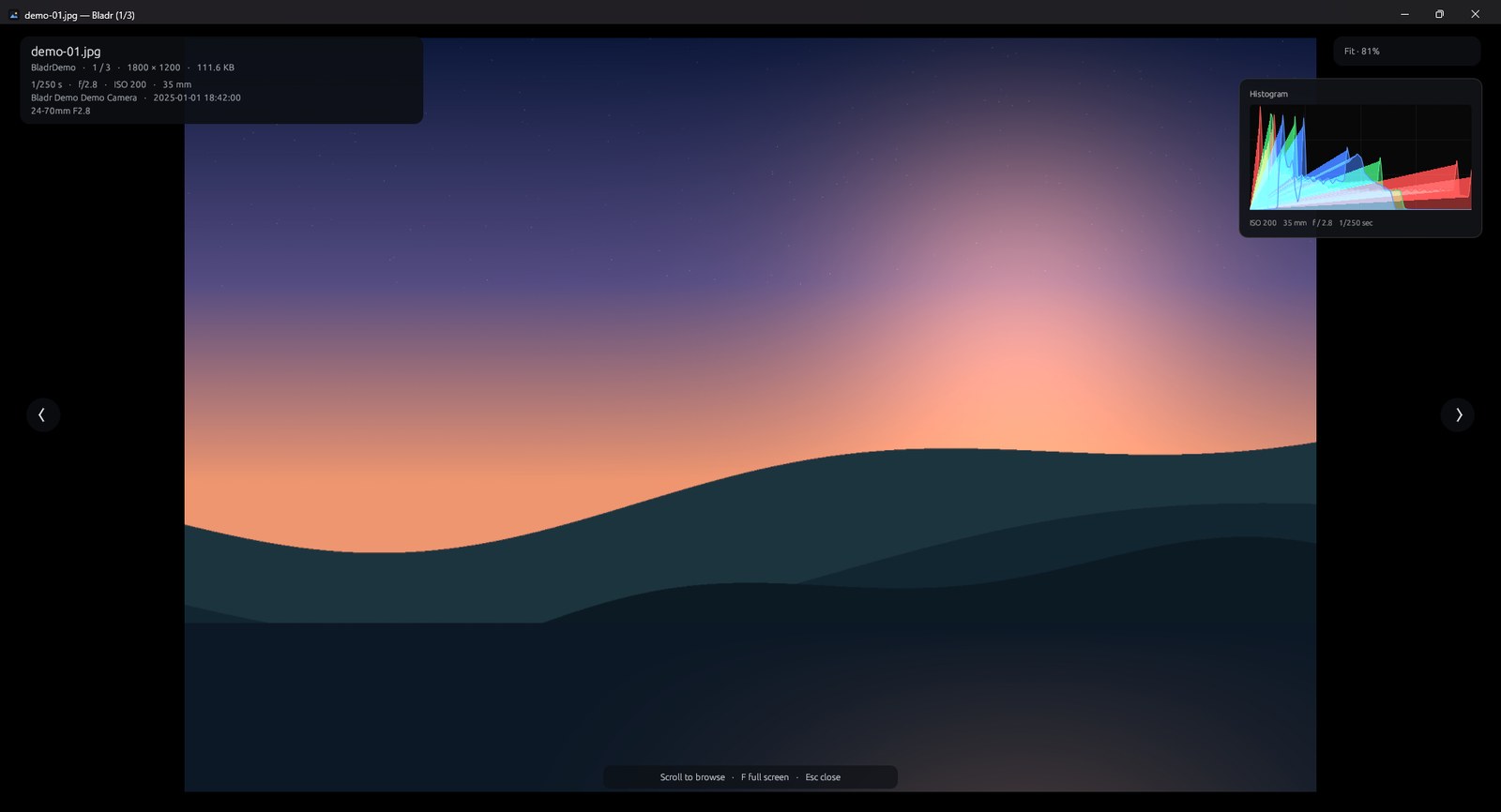
I'm the developer behind Bladr, a small image viewer for Windows written in Rust.
I built it because I missed the speed and simplicity of ACDSee's old View mode: point it at a folder, scroll the wheel to flip through photos, and press F for fullscreen. Most modern viewers feel either catalog-first, heavy, or full of ads. Bladr is deliberately just a viewer — no catalog, no editing, no account, no telemetry.
What it does:
- Mouse wheel moves to the next/previous image and wraps at the ends
- Fullscreen with F/F11, fit/100%, zoom and pan
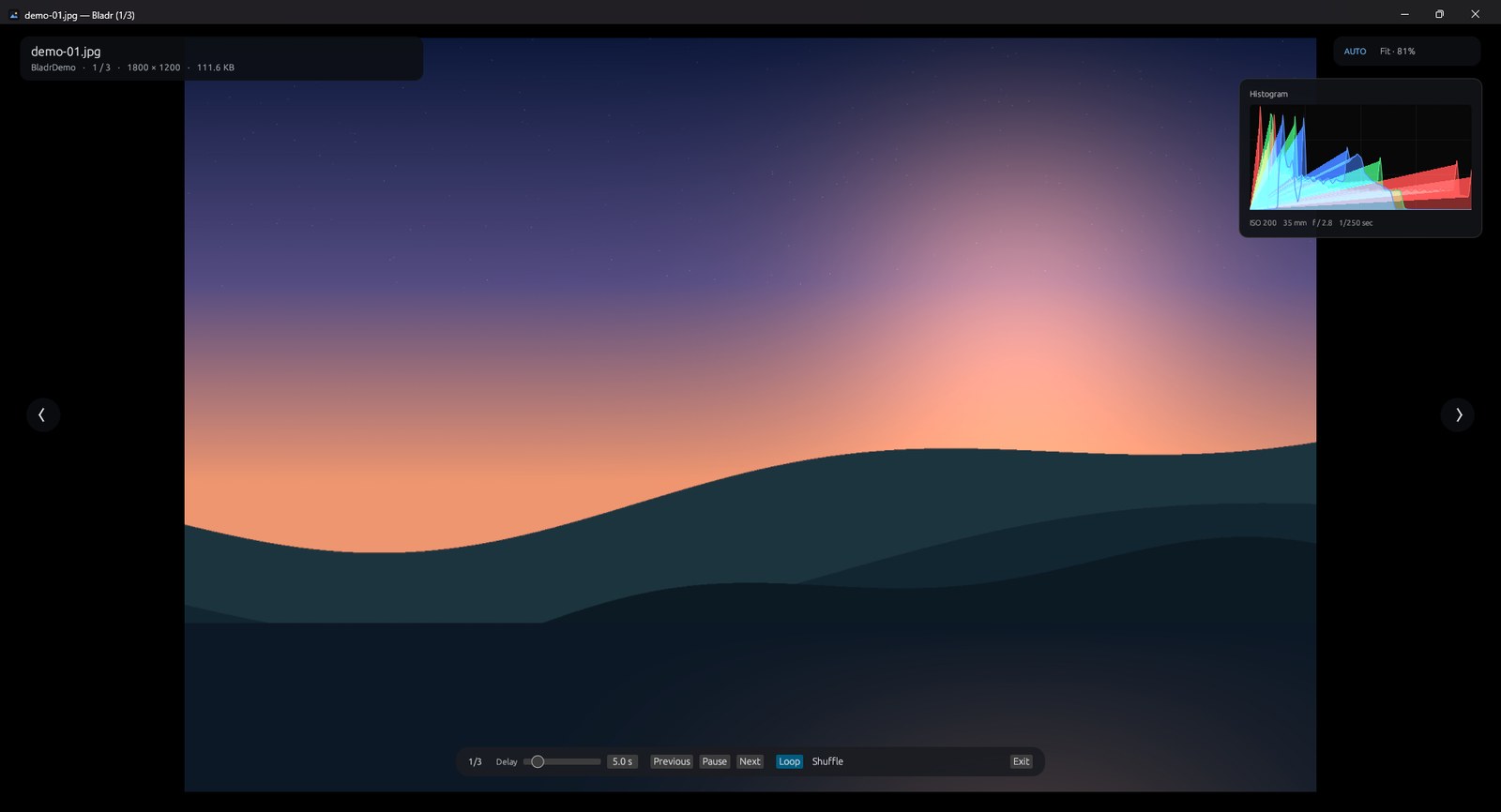
- Slideshow with adjustable delay, loop and shuffle
- RAW support through the camera's embedded JPEG preview: CR3, NEF, CR2, ARW, DNG, ORF, RW2, RAF and more
- EXIF overlay with camera, lens, ISO, shutter, aperture and focal length
- RGB histogram overlay
- Canon CR3 focus-point overlay
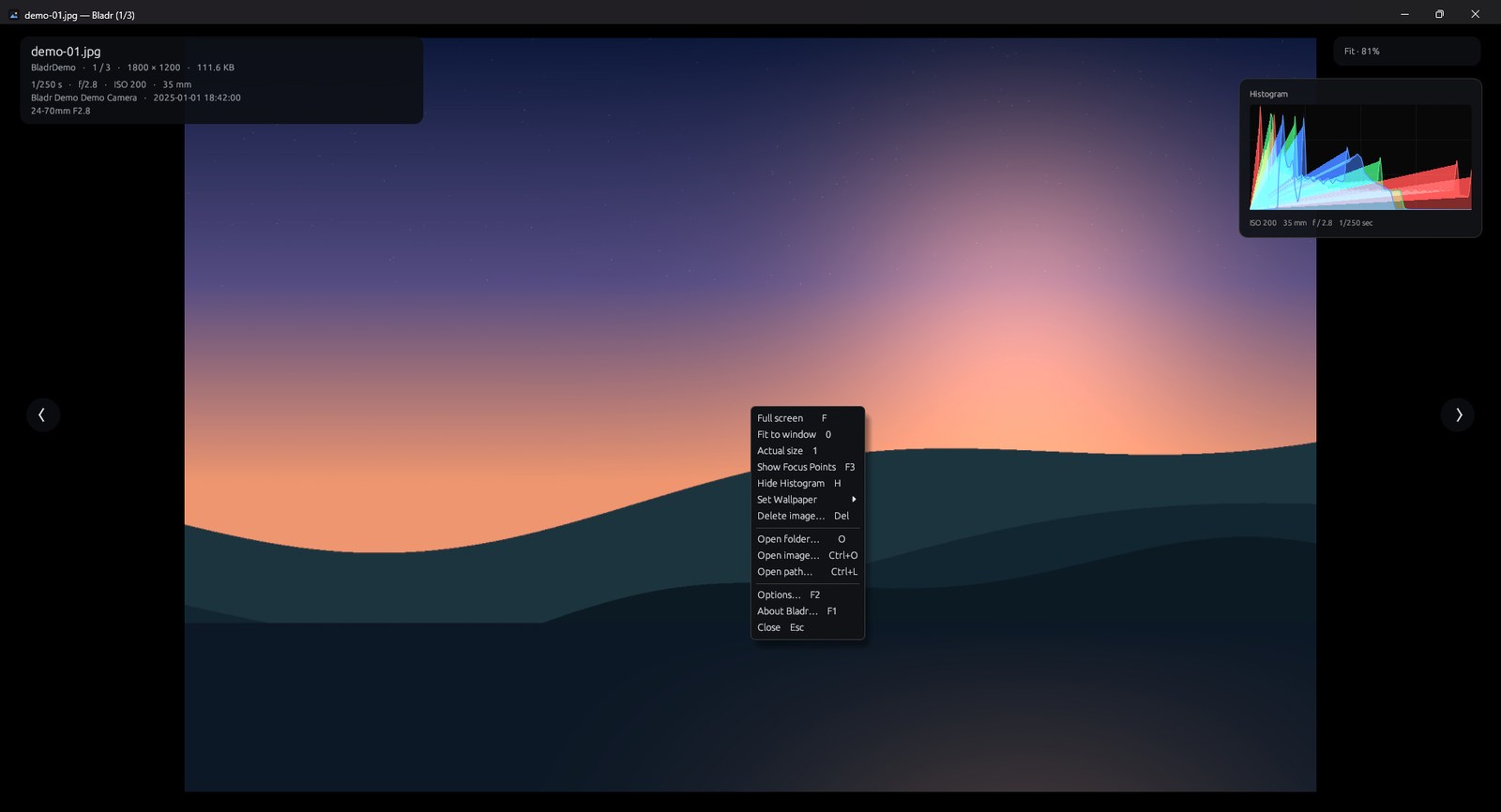
- Set wallpaper, delete to the Recycle Bin, and "Show file location" in Explorer
- Region screenshot: drag an area, then copy it to the clipboard or save it as PNG
- Single instance, drag & drop, NAS/UNC paths, auto-update
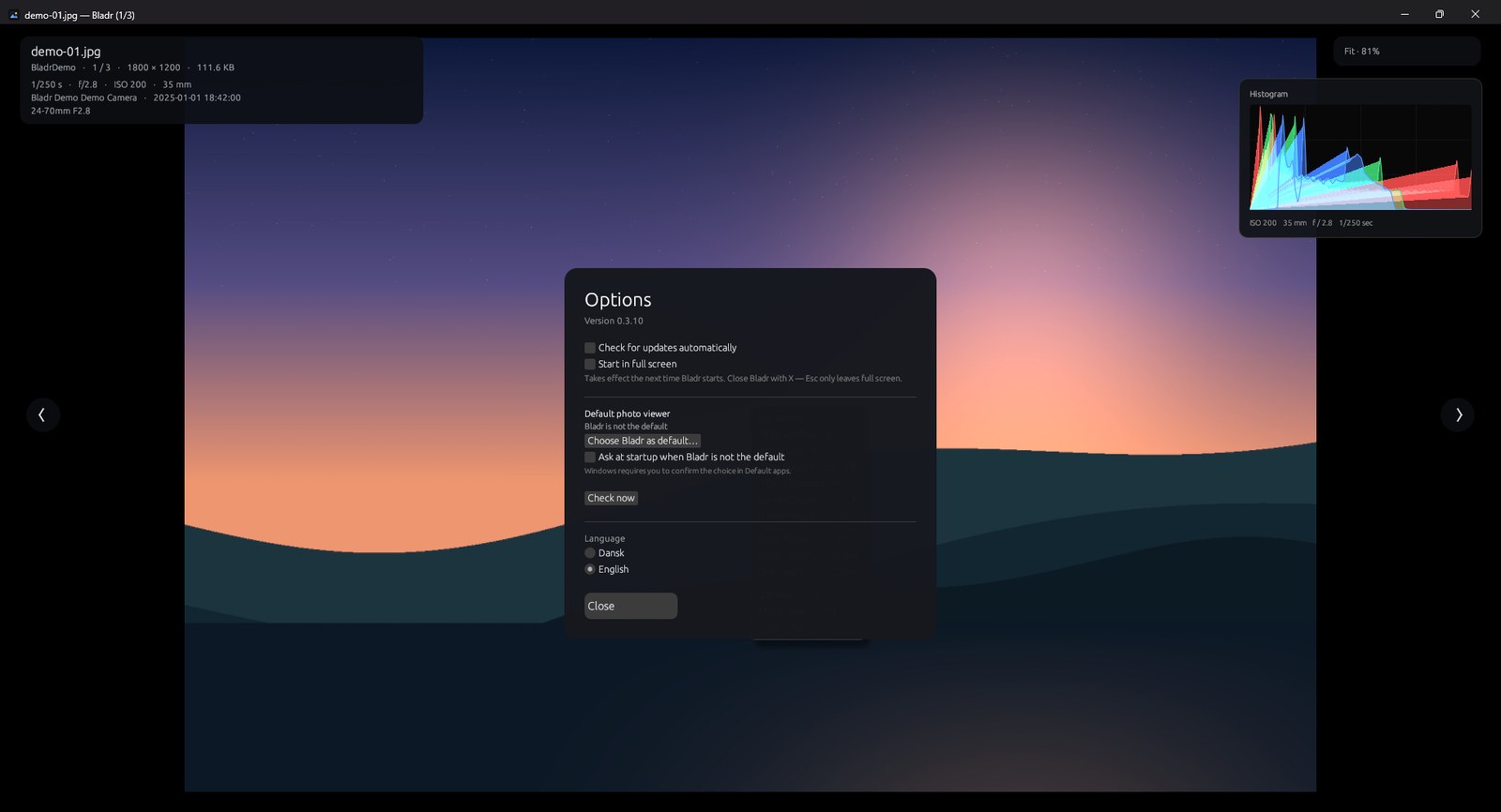
- English and Danish UI
- Starts maximised and remembers the last folder
A few Rust/implementation details:
- UI is eframe/egui with a custom canvas, HUD and overlays
- Background decoding and neighbour prefetching keep browsing responsive
- The previous image stays on screen until the next one is decoded
- Win32 integration for file associations, single-instance handling, Recycle Bin deletion and an elevated delete helper
- Portable single exe, MIT licensed
Screenshots:
Viewer with HUD, EXIF and histogram:
https://raw.githubusercontent.com/JonathanNet/bladr/main/docs/screenshots/viewer.jpg
Context menu:
https://raw.githubusercontent.com/JonathanNet/bladr/main/docs/screenshots/menu.jpg
Options:
https://raw.githubusercontent.com/JonathanNet/bladr/main/docs/screenshots/options.jpg
Slideshow controls:
https://raw.githubusercontent.com/JonathanNet/bladr/main/docs/screenshots/slideshow.jpg
Download and source:
https://github.com/JonathanNet/bladr
https://github.com/JonathanNet/bladr/releases/latest
There is an installer and a portable exe. It's Windows 10/11, per-user install, no admin required. The exe is not code-signed yet, so SmartScreen may show a warning the first time.
Current limitations, so nobody is surprised:
- Windows only
- RAW is the camera's JPEG preview, not a full demosaic
- No HEIC/HEIF or video yet
- No catalog, metadata editing or non-destructive editing
- Focus points are Canon CR3 only
- Animated GIF/WebP shows the first frame
I'd especially like feedback on startup/browsing speed, RAW formats, and whether the keyboard/mouse workflow feels right. Bug reports and format requests are welcome.
If it's useful, there's an optional Buy Me a Coffee link in the repo. No pressure.
r/madeinrust • u/Green-Necessary-2325 • 18h ago

I've been working on a Windows utility in Rust + egui (eframe 0.28) to switch DNS resolvers and pick the fastest one from your own connection.
A few bits that might interest people here:
- The probe builds the DNS query by hand (12-byte header, QNAME labels, type A, class IN) and times the reply on a std::net::UdpSocket with a read timeout. No DNS crate needed for this part.
- All system work (netsh, ipconfig, probes) runs on worker threads and reports back over an mpsc channel, so the egui frame never blocks.
- The app icon is an SVG rendered with resvg in an example binary into PNG + multi-size ICO, then embedded with winresource from build.rs.
Repo: https://github.com/Devzinh/dns-switcher
Planned next: multi-sample probing (p50/p95, jitter), DoH/DoT, and detecting which anycast PoP answers. Code review and PRs welcome, especially on the probe.
r/madeinrust • u/Opening_Can_3656 • 1d ago
Hi everyone,
I wanted to share a project I’ve been building in Rust called Keen.
To be completely clear up front: Keen is not safe Rust. There is no borrow checker and no Rust type system. Instead, it is a 1:1 Rust-syntax frontend for C. It transpiles .kn code into standard C11/C23, compiles it with gcc or clang, and maps C compiler errors right back to your .kn file and line number.
let mut, fn, impl, match, for i in 0..n, *const T / *mut T) without fighting the borrow checker on day one, Keen lets you write in that style while keeping C semantics.whet (inspired by rustup**):** Installs and manages keen toolchains (whet update, whet default <version>).keen new, keen build, keen run, keen test (supports #[test] attributes out of the box), keen fmt, and keen explain E0201 for compiler diagnostics.use <stdio.h>;), supports raw C escapes (c!("#define X 1");), and can emit standalone .c and .h files.use <assert.h>;
fn add(a: i32, b: i32) -> i32 { a + b }
#[test]
fn adds() { assert(add(1, 2) == 3); }GitHub repo (written in Rust): https://github.com/romishalom/keen
Would love any feedback on the codebase, the transpiler architecture, or ideas for making the C-to-Rust transition even smoother!
r/madeinrust • u/KATO-Kanryu • 1d ago
For years, serious AI model training has been locked into a stack of Python glue code backed by C++ native plugins. Afterburner is a first-of-its-kind, pure-Rust training engine built from the ground up to train modern Diffusion Transformers (DiTs) and export deployable LoRA adapters—with zero Python runtime or C++ extension dependencies.
Powered by Burn (and CubeCL) for GPU neural-network execution and Candle for SafeTensors loading and preprocessing, Afterburner trains LoRA adapters for the Anima image-generation architecture. Even at high resolutions, the entire training workflow operates within 12–13 GB of actual VRAM, achieving practical step times on consumer GPUs while exporting standard .safetensors files ready for inference tools like ComfyUI.
While the engine is still evolving—I would rate its current training fidelity at a solid 8/10 compared to mature Python trainers—it already demonstrates clear, reliable convergence and produces genuinely usable LoRAs with strong character and structural adherence.
Modern diffusion architectures rely on three distinct components: a Diffusion Transformer (DiT), one or more text encoders, and a VAE. Keeping all of them resident in VRAM during backpropagation wastes gigabytes of memory on frozen models. Afterburner splits the workflow into two deterministic passes:
Preprocessing Pass (AFBCACHE): Encodes captions and images once using the text encoders and VAE, saving the resulting embeddings, attention masks, and latents into a keyed cache file.
Training Pass: Releases the text encoders and VAE completely, keeping only the DiT and cached tensors on the GPU for fast, low-VRAM optimizer updates.
To keep peak memory below 13 GB without sacrificing numerical stability, Afterburner combines several memory and precision controls across Burn and CubeCL:
Query-Chunked Attention: Computes attention scores in configurable query chunks (defaulting to 256 tokens) so temporary allocations scale linearly rather than quadratically with spatial token count.
Tiled MatMul Backward: Splits long-sequence linear backward passes into 512-token tiles to bound intermediate gradient workspaces.
Scoped Autodiff Checkpointing: Uses a tailored burn-autodiff setup where heavy operations are eligible for forward recomputation during backward rather than retaining every activation across all 28 DiT blocks.
Mixed Precision with FP32 Stability: Runs forward/backward activations in BF16 (--features cuda,bf16) while keeping trainable LoRA weights and SafeTensors exports in FP32 (--lora-dtype f32) to prevent small AdamW updates from rounding away.
Explicit CubeCL Pool Control: Uses fixed-memory exclusive pools, conservative pre-flight memory checks, and per-step memory cleanup to keep bytes_in_use flat across epochs without allocator fragmentation.
Afterburner implements modern rectified-flow training (target = noise - latents) with configurable flow shift (3.0), logit-normal/sigmoid timestep sampling, loss weighting schemes (none, sigma_sqrt, cosmap), warmup-cosine LR scheduling, and global-norm gradient clipping.
Because it is built on Burn, it is not tied exclusively to NVIDIA hardware. Alongside CUDA, it supports cross-platform GPU training via Burn's Vulkan/SPIR-V backend:
# CUDA BF16 training with exclusive memory pools
cargo run --release -p afterburner-cli --features cuda,bf16,fixed-memory -- `
  --device cuda --train-cache dataset.afbcache `
  --base-model anima.safetensors --output-lora afterburner-lora.safetensors `
  --epochs 3 --learning-rate 1e-4

# Vulkan / SPIR-V training
cargo run -p afterburner-cli --features vulkan,checkpointing -- `
  --device vulkan --train-cache dataset.afbcache `
  --base-model anima.safetensors --output-lora afterburner-lora.safetensors `
  --epochs 1
Getting a multi-billion-parameter DiT training loop to converge cleanly in pure Rust required tracking down subtle BF16/FP32 normalization boundaries and graph retention bottlenecks, which also gave me the chance to share real-world CubeCL/autodiff feedback upstream with the Burn team.
Right now, Afterburner sits at roughly an 8/10 in terms of training depth—there is still room to refine fine-grained detail convergence—but it already proves that pure Rust can handle real-world generative AI training workloads under tight 13 GB VRAM budgets with predictable memory behavior and solid, reproducible learning results.
r/madeinrust • u/jptcnde00 • 1d ago

r/madeinrust • u/TheConq7 • 1d ago

Brisvox is an open-source engine for real-time voice agents (phone and browser calls with an LLM agent you can interrupt). The headline: one 4 vCPU / 4 GB container held 430 concurrent calls with no failure, about 1.8 MB and 0.007 cores per call (my benchmark: fake providers that speak the real protocols over TLS, real VAD and turn models, median of 3 runs; Pipecat 1.12.0 held 10 on the same container).
What makes that possible on the Rust side:
Repo, method and raw results: https://github.com/bilal07karadeniz/brisvox
Disclosure: I designed and directed it; most of the code was written with AI coding agents.
r/madeinrust • u/Juanmidev • 1d ago

I built inodetree (MIT licensed), a fast open-source disk space analyzer for Linux written in Rust with a native egui interface.
GitHub:https://github.com/Juanmidev1/inodetree
How it's built:
• Parallel syscall walker: Bypasses std::fs::read_dir and uses raw getdents64 (with 64 KiB thread-local buffers) plus statx (AT_SYMLINK_NOFOLLOW and AT_STATX_DONT_SYNC) scheduled with rayon. On my NVMe drive, scanning / (~843,000 nodes) takes ~0.9s on a warm cache.
• 56-byte arena nodes: Stores the entire directory tree in a flat Vec with u32 indices, a contiguous UTF-8 string pool, and u16 interned file extensions instead of millions of heap allocations.
• Accurate du-style accounting: Discovers real mounts via /proc/self/mountinfo to stay on a single filesystem, deduplicates hard links across threads using a sharded (dev, ino) set, and lets you toggle between allocated disk usage and logical size anytime.
• Three synced views: A virtualized size-sorted directory tree, a file extension breakdown that highlights matching files on click, and a nested squarified treemap rendered into a single shared Mesh.
• Live filtering & cleanup: Instant substring or glob search (Ctrl+F), Freedesktop Trash or permanent deletion with O(depth) arena updates (no rescanning needed), plus a --headless CLI report mode.
Pre-built .rpm packages and tarballs (x86_64 and aarch64) are up on GitHub Releases, or you can build it from source with Rust 1.85+. Feedback and benchmarks on other filesystems like ZFS or Btrfs are welcome.
r/madeinrust • u/tritondm • 1d ago
Hi,
I got tired of deploying heavy monitoring stacks like InfluxDB, Prometheus or Grafana just to keep an eye on local traffic spikes and weird network behavior, so I built a small single-binary tool in Rust for it.
Repo: https://github.com/tritondm/snia-net-mon
It captures flows and stores aggregated metrics in hourly SQLite files (keeps writes fast and cleanup simple). For catching traffic spikes without manually tuning static thresholds, it uses self-learning EWMA / Z-score tracking (details here: https://github.com/tritondm/snia-net-mon/blob/main/FEATURES.md#anomaly-detection).
You can try it out via cargo:
cargo install snia-net-mon
snia-net-mon --help
Since this is still an active side project, I'd love some feedback on the Rust codebase, SQLite performance under higher packet load, or how you handle lightweight anomaly detection in your own setups.
any feedback is welcome
greets tritond_dm
r/madeinrust • u/horace_h • 1d ago

Hello!
Keel is a super fast, statically-typed interpreted programming language written in Rust that I've been working on for a while.
The design goal of Keel is to have a syntax that's roughly similar to Rust (with some stuff also borrowed from C and Python) but that's still as easy as or close to Python.
In 0.5 ("Major Tom" is the name of the release), proper match blocks have been added, along with major VM and compiler upgrades that make Keel much faster (as the benchmarks show). There's now also a very experimental and simple package manager that allows anyone to publish and download packages through GitHub, along with many smaller improvements
I'm open to contributors, and of course any feedback is very welcome.
Please note that Keel is very experimental (and uses the nightly toolchain), and that it's still very early so it's prone to potentially changing a lot.
The repo is https://github.com/horacehoff/keel
There are docs (WIP too): https://docs.keel-lang.com/
You can also try it online here: https://keel-lang.com/playground
r/madeinrust • u/azj4t • 2d ago
GitHub: https://github.com/norifm/nori | Website: https://norifm.com
We just shipped nori 1.0 (AGPL-3.0), a music player for Navidrome/Subsonic servers — plus YouTube Music and SoundCloud via plugins — built around one shared Rust workspace.
Every playback, queue, DSP, lyrics, download, and sync decision lives once in Rust. Each client is just a thin UI shell over it:
cpal + MPRISratatui@CriticalNative / @FastNative on direct buffers) for the hot audio pathno_alloc tests guarding the audio path and hardware offload on Android.nori-time), so playback, AutoMix transitions, and buffering are tested without thread::sleep.plugin-sdk).Downloads for Android (APK), Linux (AppImage, Flatpak, .deb), macOS (.dmg), Windows, Terminal, and iPod touch (.ipa) are on GitHub Releases and norifm.com. Happy to dig into any part of the Rust architecture in the comments.
r/madeinrust • u/MainPepper3432 • 1d ago
Hi r/rust! I built RestGuard, an open-source break reminder for Windows, macOS and Linux. It's a rewrite of ProtectEyes, an old C# Windows-only app of mine. What's different from Stretchly/Workrave: it can enforce breaks. On "High" the overlay covers every monitor and can't be closed until the break ends. Medium and Low are softer. Some implementation bits that might be interesting: One overlay per monitor, and it stays there. Each display gets a borderless, always-on-top webview window. Coordinates were the tricky part: Windows/Linux use physical pixels (so mixed-DPI setups don't misplace windows), but macOS uses logical points, because mixing a Retina screen with a regular external display leaves physical pixels without a shared coordinate space. A Moved handler pulls a window back if it's dragged (or Win+Shift+Arrow'd) off its screen. macOS: covering the menu bar, the Dock and full-screen apps. always_on_top is only the floating window level, so via objc2 I raise the NSWindow to the screen-saver level and set CanJoinAllSpaces | Stationary | FullScreenAuxiliary, so it also shows up inside other apps' full-screen Spaces. Making it unclosable. CloseRequested is intercepted with prevent_close(), so Alt+F4 does nothing; the app itself removes overlays with destroy(), which skips that event. On macOS I turn off Tauri's default menu (it has Cmd+Q) and install an Edit-only one, so copy/paste still works in text fields. RunEvent::ExitRequested is also blocked unless it comes from the tray's Quit, which is disabled during a break. Not interrupting meetings. When a break is due, it checks whether Zoom/Teams/Webex/etc. is in the foreground or using the microphone:
QueryFullProcessImageNameW. For mic use I read the registry store behind Settings → Privacy → Microphone (CapabilityAccessManager\ConsentStore, where LastUsedTimeStop == 0 means "in use right now"). That record can stay stuck after a crash, so I also check that the process is still running.NSWorkspace.frontmostApplication for the foreground app, plus CoreAudio's process object list (macOS 14.2+) to see which bundle is recording. Recording often happens in a helper (com.microsoft.teams2.helper), so bundle IDs are matched by prefix. On older macOS it falls back to "is the default input device running somewhere".ureq from rustls+ring+bundled roots to the OS TLS stack saved ~1.4 MB. With LTO, codegen-units = 1, panic = "abort" and strip, the binary is about 4 MB. Repo: https://github.com/HansTanzi/RestGuard (MIT / Apache-2.0) Feedback on the code is very welcome, especially on the meeting detection and on a sane way to detect the foreground app and mic use on Linux (X11 vs Wayland…).r/madeinrust • u/ifblackdevice • 1d ago

Sping 1.9.0 is Out! 🚀💪🏻
If you want to try 👇
🍺 macOS and Linux with Homebrew
brew install sping
The project's tap is still available on macOS with `brew install LambdaBytes/tap/sping`.
🐧 Debian testing (forky) and unstable (sid)
sudo apt install sping
🪟 Windows x86_64 with Scoop
scoop bucket add lambdabytes https://github.com/LambdaBytes/scoop-bucket
scoop install lambdabytes/sping
🦀 Cargo on Linux, macOS, and Windows
cargo install sping --version 1.8.0 (Rust 1.88 or later)
📦 Direct download
Binaries for Linux (including static builds with musl), macOS Apple Silicon, and Windows x86_64. There are also .deb packages for Debian, Ubuntu, and Raspberry Pi OS on amd64 and arm64.
https://github.com/LambdaBytes/sping/releases
🛠️ From source code
Clone the repo and run `cargo build --release`.
r/madeinrust • u/SIMD-Enthusiast • 1d ago
https://github.com/DylanCosto/ggv
an IGV re-write for power users, uses GPU to render reads. Desktop app, command line and MCP server for BAM/CRAM, VCF and gene annotations.