r/smalltalk • u/pdxpatzer • 1d ago
Alan Kay: Steve Jobs, Xerox PARC, Marijuana

17
Upvotes
r/smalltalk • u/Smalltalker-80 • 2d ago
Hi all,
Some of you might remember Little Smalltalk, a minimal Smalltalk implemented in C by Timothy Budd ( https://littlesmalltalk.org ). The purpose of this project was to teach how to implement a working Smalltalk VM on a working Smalltalk image. The code was written in C, with the tools and style of the 1990-ties...
I took the C source code and converted it to modern C++, interacting with Claude AI, but every line of code was checked by myself. The C++ code is now OO itself, so structured much better, with classes, shorter methods, longer variable names, less globals, no macro's, etc..
The Smalltalk code was extracted from a single large source file to one-file-per-class, so it can be easily edited in an IDE like VSCode. Unit tests were added and available examples made operational again.
Its of course still open source and free, and the repo is here:
https://github.com/FunctionPoint/LittleSmalltalk
I've tested it to work on Windows, Linux and MacOS.
Feel free to check it out and give some feedback. I don't plan to make a career out of this one :-), but will implement any reasonable improvement requests.
r/smalltalk • u/ApprehensiveGuava342 • 4d ago
r/smalltalk • u/ApprehensiveGuava342 • 7d ago
Just joined this community. Hope to meet some interesting people and have good conversation here.
r/smalltalk • u/RaccoonOk3032 • 7d ago
Just joined this community. Hope to meet some interesting people and have good conversations here.
r/smalltalk • u/UKSmalltalk • 14d ago

r/smalltalk • u/diogenic • 14d ago

https://github.com/areichow/pybrowser
I hope this is OK to post here - I felt like fellow Smalltalk heads who also work in Python would appreciate it.
PyBrowser is a code browser inspired and based on the classic Smalltalk Class Browser, with dreams of becoming a more complete dynamic Smalltalk-like development environment, with the ability to pull up Smalltalk-style Inpsectors and Debugger.
At this stage of development, it's somewhere between a toy and a tool. I haven't used it for developing on large codebases, but I have used it for some small apps with a handful of files. I've used it to browse and understand existing Python codebases like Django.
There are Class Browser elements of many Python IDEs, but I've never found one that really captured the look, feel, and clarity of the Smalltalk Class Browser, let along enabled the kind of interactive development that Smalltalk is known for. Historically, the recommendation has been to use the Emacs Class Browser (ecb) or oo-browser. I'm not an experienced Emacs user and haven't been able to get either to run.
If you give it a whack - let me know what you think!
r/smalltalk • u/UKSmalltalk • 18d ago

r/smalltalk • u/UKSmalltalk • 19d ago

r/smalltalk • u/UKSmalltalk • 20d ago

r/smalltalk • u/UKSmalltalk • 21d ago

r/smalltalk • u/larryblanc • 24d ago
Hi!
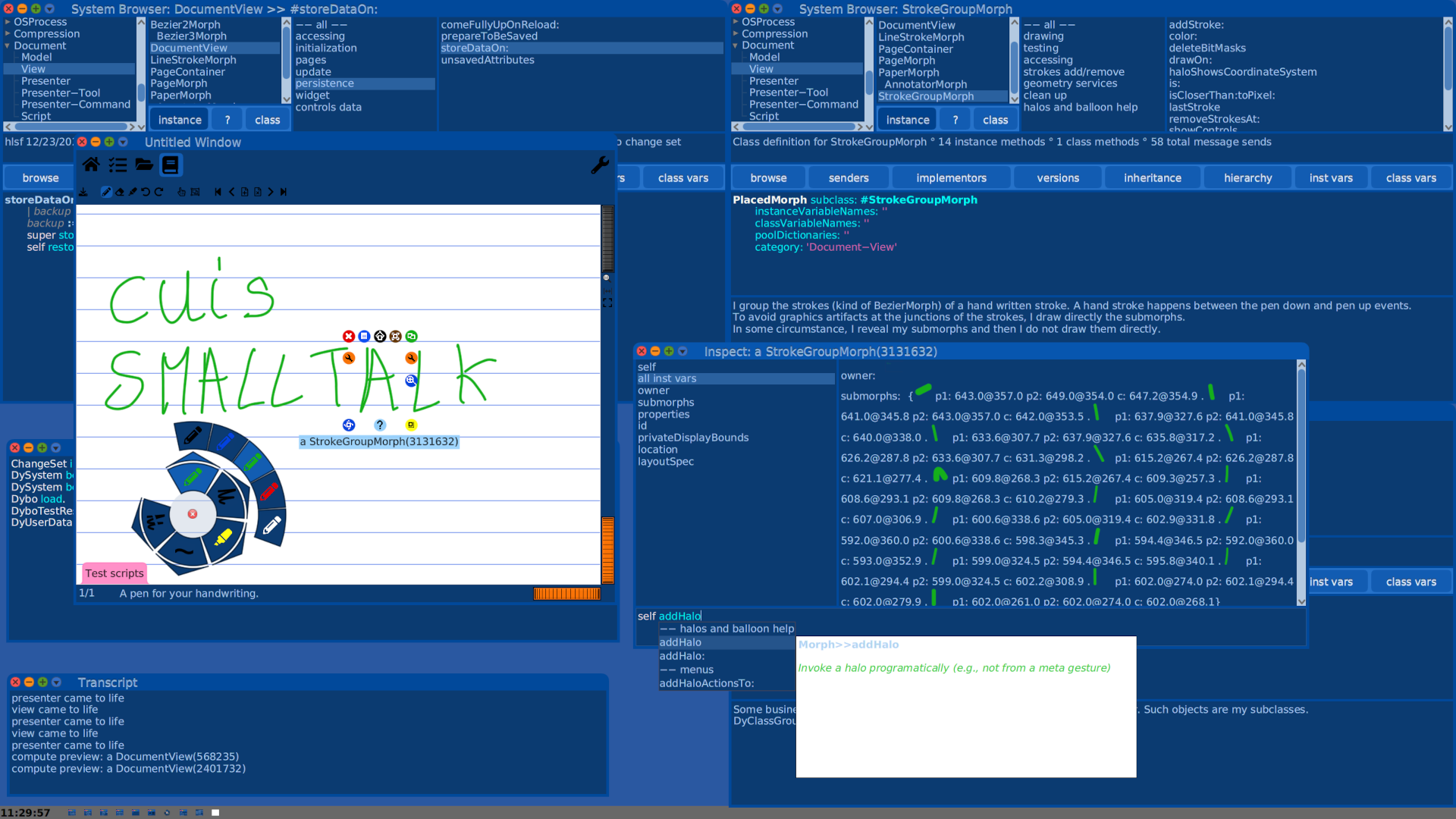
We have this new release of the DyboApp, it is developed with the Cuis-Smalltalk system. Among new things there is the concept map DKM.
To know more read the full announcement.
DyboApp homepage - https://github.com/Dynamic-Book/DyboApp
r/smalltalk • u/UKSmalltalk • 29d ago
Pulsar is an experimental IDE for Pharo, built with Spec. It aims to give programmers more leverage in their everyday work through faster navigation, richer feedback, deeper inspection, persistent lines of investigation, and a more fluid relationship with the running image. It is not simply a new browser, but an attempt to rethink the IDE as a coherent workbench for understanding, modifying, and evolving software.
Esteban Lorenzano ( https://github.com/estebanlm ) studied Computer Sciences at Universidad de Buenos Aires, and worked since 1994 in several object-oriented and low-level technologies, in different software companies, serving in various positions from programmer to senior architect. In 2007 he co-founded Smallworks to offer Pharo-based agile development projects. Since 2012 he dedicated full time to developing the Pharo code and community. He works with the INRIA-EVREF team in Lille, France, as core developer for Pharo, being responsible with the coordination of new releases and the implementation and maintenance of several Pharo libraries.
This will be an online meeting.
If you'd like to join us, please sign up in advance on the meeting's Meetup page ( https://www.meetup.com/ukstug/events/317153223/ ) to receive the meeting details.
r/smalltalk • u/Key_River7180 • Oct 22 '26
I am saying something like https://cuis.st/assets/imgs/home/ide.png
r/smalltalk • u/dharmatech • Oct 20 '26

r/smalltalk • u/Simsiano • Oct 19 '26
Hi everyone,
I would like to ask you all some recommendations on learning material for Smalltalk, the language itself, and it's development enviroments (Pharo, Squeak, ...).
I come from 4 years of experience with Java so I would say I know the basic of programming.
Do you have any suggested guides/book/references I could look into?
Thanks in advance.
r/smalltalk • u/Smalltalker-80 • Oct 18 '26
I'm delighted to report the release of SmallJS v2.3. This is a big one!
SmallJS is a Smalltalk-80 dialect that transpiles to JavaScript that can run in browsers and in Node.js.
The website is here: small-js.org
The full, free, open source code is here: github.com/Small-JS/SmallJS
Notable changes in this release are:
Compiler
Debugging: Enhanced debugging in SmallJS by allowing breakpoints in more places: In assignments, constant statements and especially with blocks! Step-into debugging is now disabled for common classes like Integer and String, giving a nice, streamlined debugging experience.
Smalltalk library
Electron: Added full support for core Electron JS base classes. Updated the Electron example app to show it off. The example app NodeGui has been moved to contributions, leaving NW.js and Electron as fully supported desktop options.
Browser: Added functionality and tests to classes: Animation, FromData, History, Iframe, Permissions, Storage, WebWorker, Canvas, DomMatrix, Geolocation, Clipboard, MediaQuery.
Node: Added functionality and tests to classes: Fs, Fsp, NodeWorker, Buffer, NodeMessagePort.
Core: Added functionality and tests to classes: Event types, File, streams.
AI: Expanded option support for Anthropic.
Tutorial
AI: Tutorial video to create a Tic-tac-toe game in SmallJS using Claude AI! See the Tutorial home page for the link. Claude writes the SmallJS code, which is well structured and maintainable.
Disclaimer
The code in this release was partially built with AI (Claude).
Great care was taken ensure that every generated line of code
conforms to the code quality standards of the existing project.
r/smalltalk • u/UKSmalltalk • Sep 28 '26
Deploying a Smalltalk image as a service raises a new class of questions, and answering requests is the least of them. What are the ins and outs of a running image — what do you put in, what does it report back out? And what about its ups and downs, now that staying up is the job?
Canopy, grown out of running ApptiveGrid in production, is one way to look at those differently: two things you normally maintain separately turn out to be the same thing. Along the way we work out what actually matters when you have to keep a service running — and what follows from that is the rest of the talk.
Norbert Hartl is an experienced software engineer and entrepreneur with a strong track record of delivering business projects and developing key libraries and frameworks. As the co-founder of ApptiveGrid he focuses on creating efficient, zero-dependency software solutions that drive business innovation and streamline operations.
This will be an online meeting.
If you'd like to join us, please sign up in advance on the meeting's Meetup page to receive the meeting details.
r/smalltalk • u/parallel-minds • Sep 25 '26
A computer should be a living medium, not a toolbox. The program, operating system, live world environment, and development environment should be one thing, not four things communicating through APIs.
neo is that one thing: a live, homoiconic, classless, prototype based, pure object system that is simultaneously a programming language, an operating system, and a game engine (live world environment). Not three subsystems, but three ways of looking at the same object graph.
r/smalltalk • u/Smalltalker-80 • Sep 20 '26
This video shows how to make a fully working browser game of Tic-tac-toe in SmallJS ( https://small-js.org ) using Claude AI. Claude generates all code including unit and GUI tests, with just simple prompts, starting form a working Counter app (harness) and having access to a file with SmallJS contextual knowledge.
The generated code is concise, clean, structured, commented, and has unit and GUI tests.
So its also maintainable by humans going forward.
This can be used as a quick-start for coding your own SmallJS app.
Youtube video link: https://youtu.be/4_ir6h2MIRg
If you want go ahead quickly yourself and and make another app, here is the 'script' for the video below.
To see the resulting generated app, look in the SmallJS repo and goto the folder `Contributions/Tictactoe`.
# Creating a Tic-tac-toe browser game in SmallJS using Claude AI

## Intro

This video is about using the AI Claude
to create a browser game Tic-tac-toe in the language SmallJS.
To do this yourself, you need a payed Claude Pro subscription form Anthropic.
It costs about $20 per month. So its affordable and currently the best.

## Install SmallJS

- Goto official website: `https://small-js.org`
- Goto SmallJS repo: `https://github.com/small-js/smalljs`
- Goto and open `Installing.md`

## Setup VSCode with Claude

- In the SmallJS repo, create folder `./Private`.
- Copy folder `./Examples/Counter` to `./Private`.
- Navigate to folder `./Private`.
- Rename folder `Counter` to `Tictactoe`.
- Rename workspace file `Counter.code-workspace` to `Tictactoe.code-workspace`.
- Open workspace file `Tictactoe.code-workspace` in VSCode.
- Run the bash script `getAiContext.sh`.
- Notice there is now a file `smalljs.txt`.
- Notice the contents of `CLAUDE.md` also referring to `smalljs.txt`.
- Make sure the VSCode extension `Cloude Code` in stalled and you have an account.
- Open extension `Cloude Code` in the right pane in VSCode.
- Start the static web server by running the bash script `startWebServer.sh`.

## Convert Counter app to Tic-tac-toe game

- Open the app model file `./src/Counter.st`
- Prompt Claude with: `Convert SmallJS class Counter to class Tictactoe`.
- After a minute or so, Claude has completed the request.
- But now it notices that the model does not match the app and tests anymore.
- Cloud asks you how to proceed. Select `Convert the whole app now`.
- Notice Claude is quickly learning the SmallJS language and library parts.
- After a few minutes the app should be complete with running tests.
- Check if everything works.

## Improving the app

- Check the chosen computer strategy, random to best move.
- Switch to the other startegy with by prompting Claude with e.g.:
- `Change the method computerMove: to make the best move in stead of a random move`r/smalltalk • u/dharmatech • Sep 03 '26

Hey y'all 🙋♂️
Mentioning this here since the approach to objects is inspired by Smalltalk.
So much so that `if` is a message you send to booleans.
The `if` special form simply expands to the message passing form.
I sometimes wanted a Smalltalk with Scheme syntax.
And, I sometimes wanted a Smalltalk with types and type-inference.
This is experimenting with both of those.
This is an experimental language prototype.
It doesn't even have strings yet!
But there's enough there to simulate a flock of three boids:
https://github.com/dharmatech/2026-09-02-aloe-racket/blob/main/examples/boids.aloe
Currently weighs in at around 2000 lines of Racket.
r/smalltalk • u/parallel-minds • Aug 31 '26
The traditional way of building systems is usually with low-level systems languages such as C or C++. As you know, those systems were traditionally built with efficiency in mind first, since computer resources were historically scarce. I have a minor passion for building game engines or live, interactive worlds.
It was only recently that I became aware of the origins and importance of modern high-level languages such as Java and C#, tracing their roots back to Smalltalk and Self while only briefly looking into the functional paradigm through Haskell.
Now, honestly, I’m very impressed by the work of those who developed the functional and object-oriented paradigms through languages such as Smalltalk, Self, and Haskell. Building a system however hobbyist or small seems more and more like a missed opportunity if I take the C/C++ route, or even the Java/C# route, given that the latter languages copied their object-oriented ancestors in a very shallow sense. For example, not everything is an object in either Java or C++.
There lies but one small problem. Self and Smalltalk are both relatively unfinished works, especially Self, which takes the prototype approach and eliminates classes altogether. I mean, what’s not to love? A prototype-based, live environment in which to build a game engine seems like a match made in heaven. Except that, in the case of Self specifically, nothing works at a level where you can build anything presentable or shippable (at least to your peers) and, frankly, I’m not a professional software designer on the level of Alan Kay, so I can’t extend these semi-abandoned projects to meet my own needs. Writing a basic, toy-style engine with PBR is about as far as my skill ceiling goes in this hobby, using tooling that someone else has made and maintains for me. That is, unless we’re talking about a basic C compiler.
So now I’m stuck trying to paint something with a poorly hacked brush called C++/C#, or with an incomplete prototype of something genuinely better: Self.
Anyhow, some advice would be nice.