r/LocalLLaMA • • 22h ago

Discussion PSA: google is actively banning pi.dev gemini connectors

0 Upvotes

I know this is not strictly local LLM, but I do use cloud models for auxiliary work like research and review some non-sensitive data;

Was met with a "violation of terms of service" today.

Yet another anecdote why local llm matters


r/LocalLLaMA • • 5h ago

Discussion How to never cross into LLM Looping ever again

2 Upvotes
  1. chat template that comes with default often is not that great. if its a new model give it some time people will come up with chat template fixes.
  2. inference engines will need to fix the tokenizer. -- on first few weeks of a new model architecture on launch alway expect looping and weird behavior until inference engine fixes.
  3. only download quants that showcase their KDL -- dont use any quant whose KDL is higher than 0.04 higher than 0.04 you are basically begging for loop to happen.
  4. For the love of god dont let your system prompt be too big. a 26b LLM working on a harness with a system prompt of 60k you are also begging for loop to happen. use something light like pi-coding-agent number if active params is the biggest factor the more active params the less it loops
  5. -------
  6. -------
  7. following these rule of thumb and i almost never get looping anymore no matter what model i download. these are the traps once u avoid them you should be fine

r/LocalLLaMA • • 6h ago

News AI agent ARTEX planted malware on Hugging Face and leaked its own keys

Thumbnail
maccus.fr
27 Upvotes

13 repos were infected


r/LocalLLaMA • • 14h ago

Question | Help Inkling 2 Small thoughts?

14 Upvotes

Has anyone started using Inkling 2 Small? The hype around Mini has drowned out a lot, including Small. (I found a post when it was released, and then another confusing Mini for Small.)

It doesn't look spectacular in benchmarks for the size, but we all know that benchmarks don't tell the whole story and it's in spitting distance of my current daily driver, DeepSeek V4.1 Flash. I imagine I'll have to do a lot more work to optimize it given the relative lack of use, so I figured I'd ask around for strong opinions first. Anyone love it?


r/LocalLLaMA • • 22h ago

Discussion Added the 4th 3090 to my Local AI setup

15 Upvotes

The last 3090 arrived today with dog's hairs and ruined bolts. After a deep cleaning, new thermal paste and pads it's ready for a stress test.


r/LocalLLaMA • • 6h ago

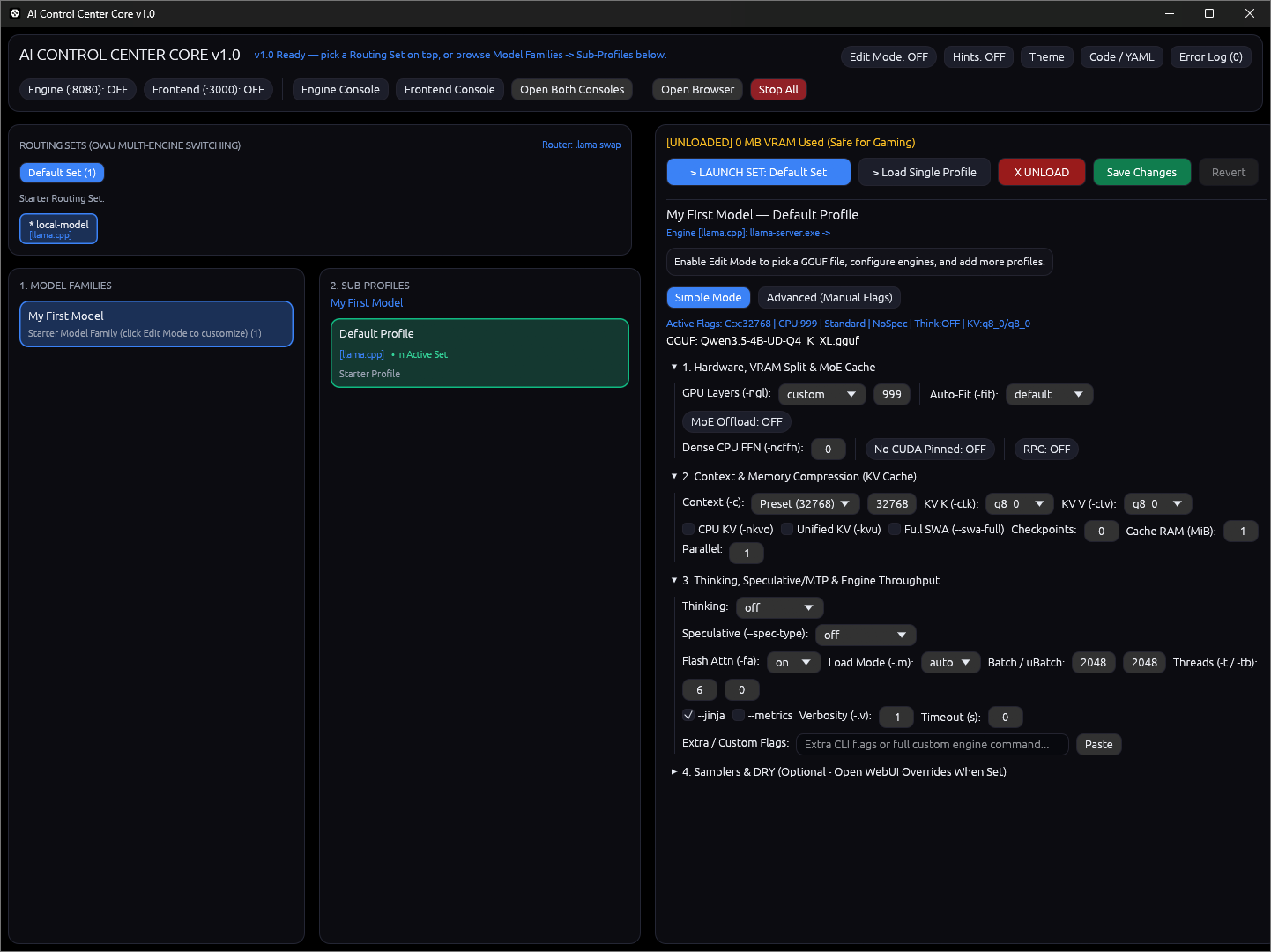
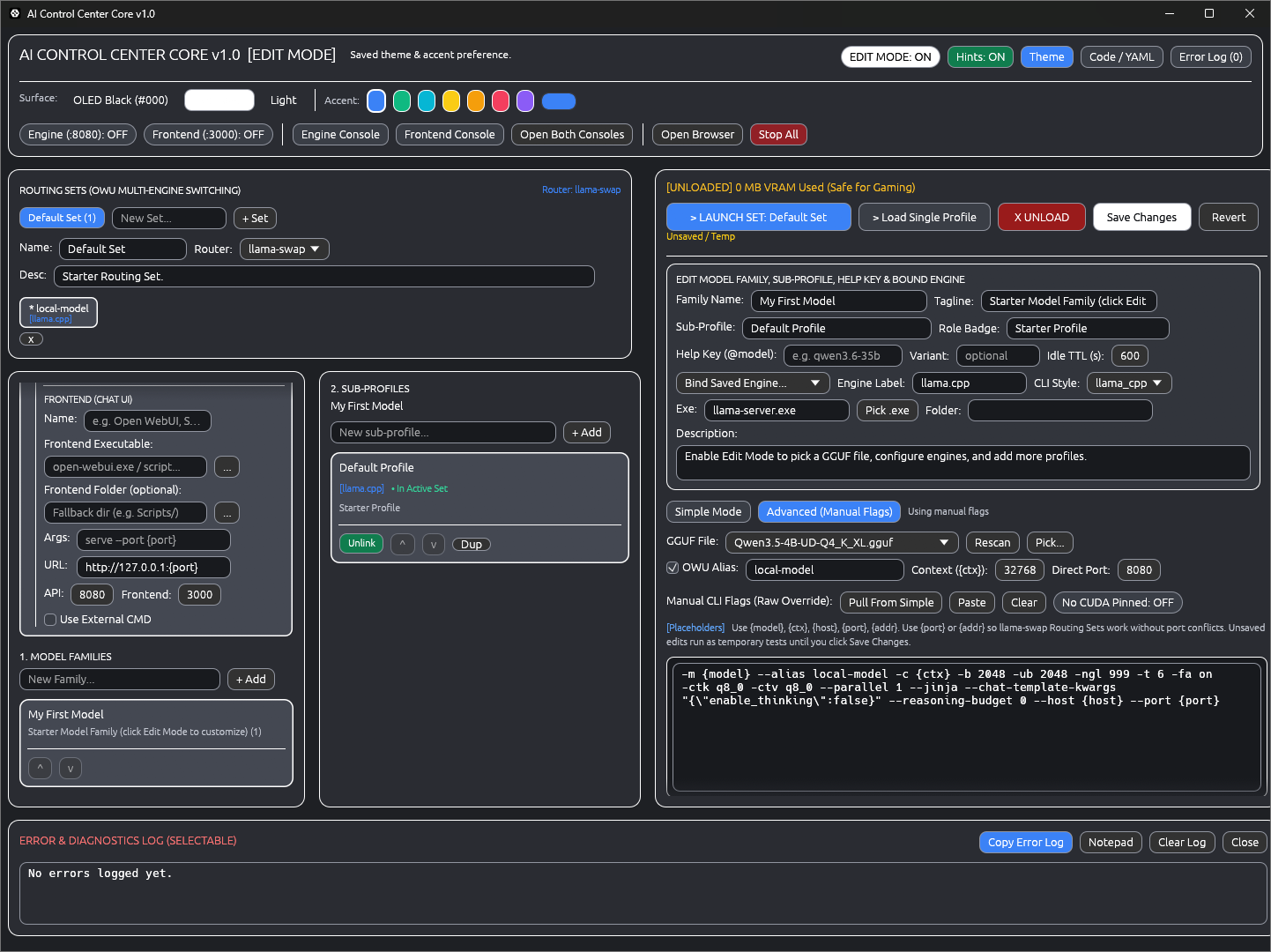
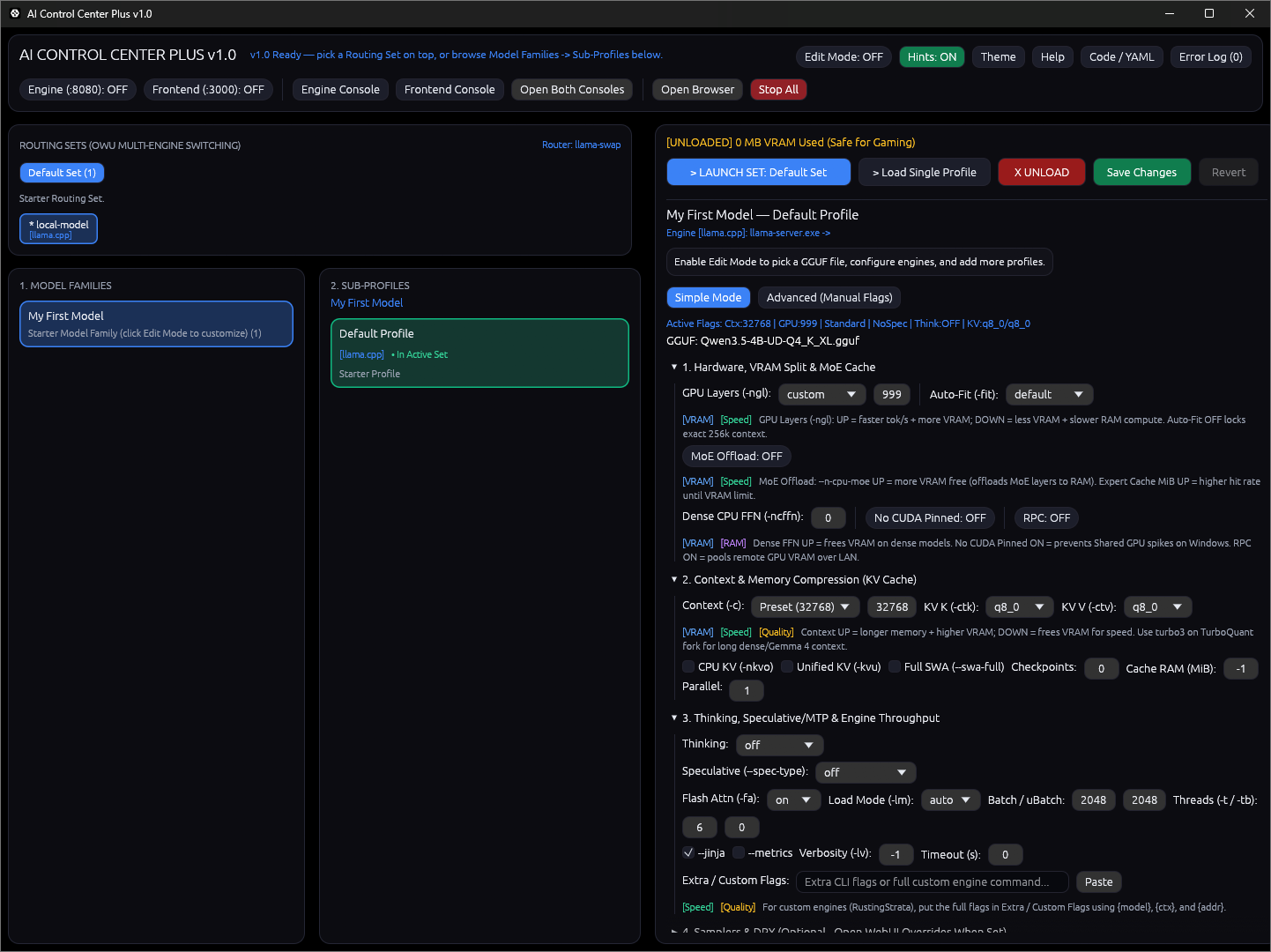
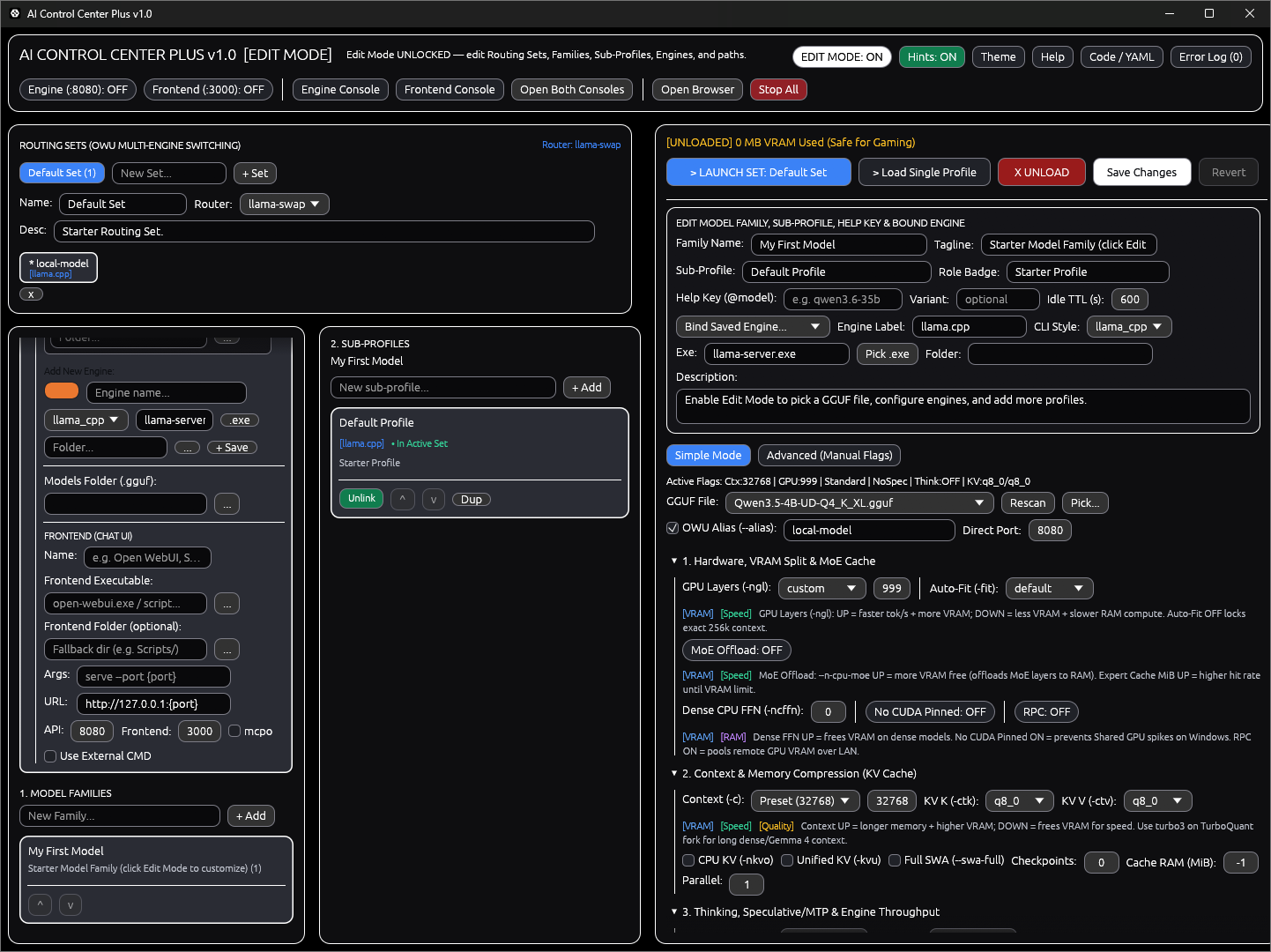
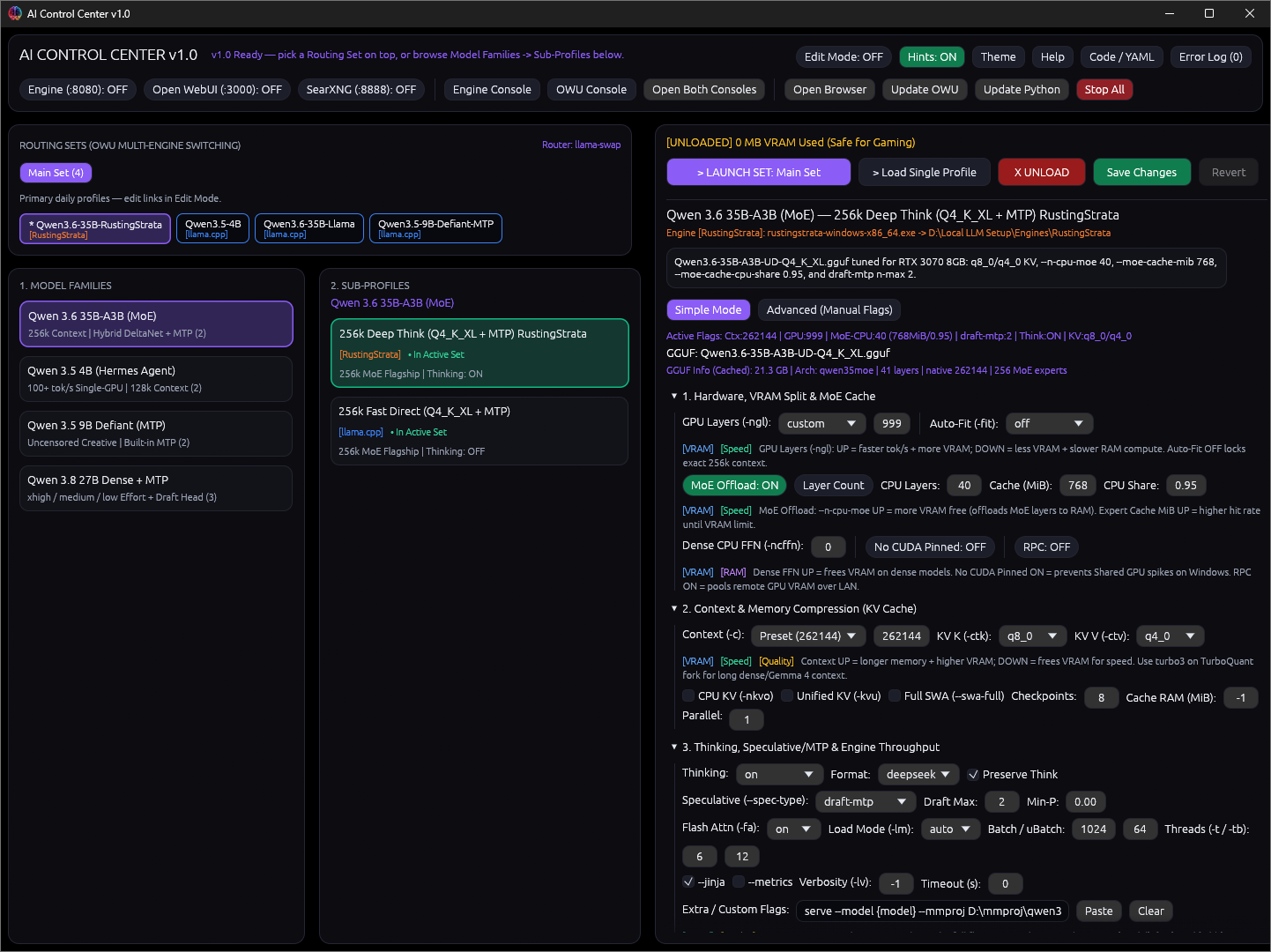
Showcase I made a native Rust GUI for llama.cpp & llama-swap that hot-swaps models and engines on the fly (Windows & Linux)

0 Upvotes

DISCLAIMER: This is completely written in Rust, and is 100% vibecoded, though thoroughly tested by me in every scenario i could think of, and worked to fix errors, GUI issues, QoL fixes.

I am not an IT guy [i am a dentist] but i personal life revolves around computers, automating stuff, making things i want etc. I, self taught in some frontend and Python, but i dont know Rust.


The What

AI Control Center

https://github.com/BaidDSB/ai-control-center

Basically, its a fast, native desktop control panel for running local AI on Windows and Linux. The BIGGEST feature is that it can hot-swap models and engines on the fly.

Configure your models, engines [you can color code engines too], front end, save your settings, and link the Routeing set and forget. You can even configure and use RPC right from the AI Control Center.

It has 2 versions, a Core and a Plus. Details are on github.

https://raw.githubusercontent.com/BaidDSB/ai-control-center/main/screenshots/core-1.png

https://raw.githubusercontent.com/BaidDSB/ai-control-center/main/screenshots/core-2.png

https://raw.githubusercontent.com/BaidDSB/ai-control-center/main/screenshots/plus-1.png

https://raw.githubusercontent.com/BaidDSB/ai-control-center/main/screenshots/plus-2.png

heres what my personal setup looks like and runs:

https://raw.githubusercontent.com/BaidDSB/ai-control-center/main/screenshots/personal.png

The Why

Well like i said before, my personal life revolves around computers and tech. I probably should have gone into IT, but i sucked at math so i didnt have the marks, nor the confidence to get into CSE. On my me time, i make all kinds of stuff, 3d models for games [i did extensive commission work in cities skylines assets, automating thing sin my pc, remote access etc].

I made this because i wanted to use local ai. I did so with LM studio but i realized i wanted more control plus Electron is slow af, so i switched to llama.cpp and OpenWebUI. and gradually i realized i want a quick launcher, which then grew into this, mostly to quick switch my models, and engines, use RPC, quick test new flags, save settings etc.

i really just made this for myself. But i decided to release this because if even 1 person find it useful, its great for me.

The Future

I have plans to integrate hermes, pi, make a dedicated RPC mode...


I hope you at lease give a read and see the pictures, even if you dont plan on using it. Thanks and enjoy!


r/LocalLLaMA • • 8h ago

Discussion What happened to Qwen 4 35B ?

0 Upvotes

Has there been any news on this?


r/LocalLLaMA • • 8h ago

Showcase Gemini Neon tuned Mac M1/M2 kernel for Inkling 2 Mini :: All Vibes and toks

2 Upvotes

I've been using my Gemini subscription to help get the most out of my Macbook M2 Max 64gb and Neon seems to have hit it out of the park with integrating different approaches to this model. All of the kernel stuff is beyond me, I simply pointed it at different references for useful information.

This may or may not be of interest to any Apple Silicon users >M2 and comes with No Warranties whatsoever. If I can't understand what the robot wrote I cannot give any guarantees.

Let the slop begin.

Title: Experimental MLX M1/M2 kernels + W4W8 quant for Inkling-2-Mini (500+ tok/s prefill, 30–43 tok/s decode, 512k NIAH in 38 GB on M2 Max)


I put together a vibe-coded experimental set of MLX Metal kernels and a matching mixed-precision quant for Inkling-2-Mini specifically targeting M1/M2 Macs (tested on a 64 GB M2 Max). No guarantees or production claims here—just sharing the code, weights, and benchmarks in case they're useful to other M1/M2 users.

Why a separate quant + kernel pass for M1/M2

  1. Affine instead of NVFP4/MXFP8: Inkling-2-Mini trains and ships natively in NVFP4 (layers 0..19 experts) and MXFP8 (last 4 readout layers 20..23). M1/M2 has no hardware microscaling decode, so unpacking NVFP4/MXFP8 in software costs ~30–40% decode speed vs MLX's affine (gs=64) kernels.
  2. Keep the last 4 layers at 8-bit: Uniform 4-bit (W4A16) gets trapped in thinking loops on long coding tasks (0/12 on a 64k DAG workflow test), and crushing layers 20..23 to 4-bit drops accuracy (10/12). Mirroring the training split—4-bit affine on layers 0..19 experts, 8-bit affine on layers 20..23 experts + attention/embed/lm_head, FP32 on AttnRes/routers—recovers 12/12 in 18 GB.
  3. FP16 activation path + fused kernels: On M1/M2, recasting BF16 leaves to FP16 alongside fused Metal kernels (short_conv, moe_short_conv, dynamic_conv, qkv_post, Split-K relative attention) and projection fusion gives a large prefill and decode jump over base mlx-lm PR #2086 (e2b5bbd) and oMLX 0.8.3.
  4. Adaptive DSpark MTP + SpeculativeRotatingKVCache: Adds 16 tokens of tail slack to the 40 sliding-window visits so MTP rollback stays capped instead of growing all 48 visits (cutting 512k MTP KV memory by 6x), plus an adaptive depth controller that backs off to d=0 on high-entropy prose while staying speculative on code/tool JSON.

Benchmarks (64 GB M2 Max)

Up to 32k context (256 generated tokens):

ContextBase PR #2086 (e2b5bbd)oMLX 0.8.3 (M1/M2 FP16, NVFP4)This (W4W8 + FP16)
512 tok365 tok/s pre / 25.9 tok/s dec301 tok/s pre / 24.0 tok/s dec549 tok/s pre / 30.9 (33.2 d=2) dec
4,096 tok417 tok/s pre / 26.7 tok/s dec498 tok/s pre / 21.0 tok/s dec603 tok/s pre / 29.9 (30.9 adapt) dec
16,384 tok407 tok/s pre / 25.2 tok/s dec504 tok/s pre / 20.5 tok/s dec543 tok/s pre / 28.2 tok/s dec
32,768 tok374 tok/s pre / 23.6 tok/s dec466 tok/s pre / 19.0 tok/s dec501 tok/s pre / 26.1 tok/s dec (21.2 GB peak)
  • Coding / tool-calling (Adaptive MTP d<=2): 37–48 tok/s (75–89% acceptance).
  • 512k NIAH (512,444 tokens, The Man Who Was Thursday + The Count of Monte Cristo): 5/5 verbatim recall across 5%–95% depth, 8.56 tok/s decode, 37.99 GB peak RAM (90.8 min cold prefill; only 8 of the 48 visits are full-attention, so KV grows at 32 KB/tok).
  • Offline KV caching: Included in inkling_mlx.py (--build-cache / --cache, 16-bit or 8-bit .safetensors including conv + drafter state, <1 ms in-memory branching). A 128k cache is 4.3 GB (2.3 GB at 8-bit) and reloads in under a second.
  • Capability checks: 12/12 on a 64k one-shot DAG workflow engine test, 12/12 on a fictional-world tool-calling suite (including a 9-file refactor and 28.6k pure long-context log debugging with 0/116 malformed tool calls), plus clean one-shot Three.js and Web Audio apps.

All converter scripts, benchmark harnesses, and the diff against PR #2086 are in the GitHub repo if anyone wants to test or pull pieces into upstream mlx-lm.


r/LocalLLaMA • • 18h ago

Discussion The administration likes open weight models so they pushed to bring back Jensen?!

Post image
124 Upvotes

https://www.wsj.com/business/nvidia-jensen-huang-white-house-9ad03961

Was not expecting this to be a factor but if true this is great!


r/LocalLLaMA • • 18h ago

Discussion Anyone else using Inkling-Mini-2 in Claude Code?

14 Upvotes

And if so, how are you finding it?


r/LocalLLaMA • • 19h ago Bravo

Discussion What happens tomorrow?

0 Upvotes

With all the drama around the business of AI, what happens if tomorrow all the open-weight model providers decide it doesn't make sense for them to keep spending money and giving their models away for free?

Or the bigger question: is local AI sustainable if we can't train our own models from scratch? Is there anything we can do about the situation?


r/LocalLLaMA • • 11h ago

New Model Dankpaws/ERNIE-5.5-Flash-Preview-DankAttn-w2-g32 - 96 GB M5 Ultra in pure Metal 4. 1,800 tok/s prefill, 65–87 tok/s decode with DankAttn.

Thumbnail
huggingface.co
13 Upvotes

r/LocalLLaMA • • 17h ago

Question | Help Experience with Hermes + Mac Studio M5 Max, 36GB RAM?

Post image
0 Upvotes

I'm really tempted to pick up the 2026 Mac Studio M5 Max 36GB RAM for $2500 to use with Hermes. I have Hermes running on a mini-PC, using medium sized OpenRouter models and local models on pure CPU and ready to move to a dedicated machine. (I can get 20 tokens/second on GPT OSS in LM Studio/llama.cpp, but a Hermes prefill adds minutes worth of overhead to each turn). Picture added for visual interest :)

Does anyone have an experience with running Qwen 27-30B models on a Mac Studio M4 or M5 with 36GB? Does it work well enough for you? Do you wish you'd invested in more RAM up front?

Your insight is greatly appreciated!

(PS, I posted something similar elsewhere - but many answers were "cloud API's are cheaper" which kinda misses the point of me asking what others' experiences were...)


r/LocalLLaMA • • 6h ago

Question | Help Is it true that even best open models are behind Haiku

Post image
278 Upvotes

Because of my personal position, I never worked with closed models. I used a lot, almost all popular open models, mostly for coding on different platforms. Last months, my main drivers are local 27B and QFN, and for heavy lifting I use cloud full Kimi or GLM. I have customized Pi harness with a lot of my custom plugins, and have no problems doing all my tasks with it, from embedded to Android.

But according to AA coding benchmarks, even K3.1 Pro is behind Haiku. Sonnet is miles ahead, whilst Opus almost streams tokens directly from intergalactic starship.

I could easily believe, that the benchmark is just corrupt by greedy Ram Altman and others, but many people on Reddit claim that it is sad, but true.

According to your experience, is that the case?


r/LocalLLaMA • • 16h ago

New Model I ported Stanford's Memorilla to 4-bit Gemma 4 26B-A4B on a single Strix Halo—and found an interesting quirk with shuffled documents

13 Upvotes

Author Note: This is written by AI, but it has been tested, the raw bench data is published, the code to verify those results is in the github, as well as the code to train it. And the adapter is on HF. If you haven't seen Memorilla yet, I highly recommend you check it out. (Picture releated) https://arxiv.org/html/2610.21375v3

Also, reddit broke the table, so I had to readd it as an image.

Stanford SNAP recently released Memorilla, a 190M-parameter Perceiver module that compresses a question and a collection of document embeddings into 16 soft memory tokens prepended to a frozen LLM. Upstream only trained and tested it on full-precision Qwen3-8B using four H100s.
I wanted to see two things:The Setup & Hardware****Results (500 test rows per benchmark, paired bootstrap 95% CIs)
I ran every test row three ways: Closed book (frozen 4-bit Gemma alone), Wrong documents (right question, shuffled documents from another collection), and Memory (right question + right documents).

Main TakeawaysUpstream's paper didn't include a shuffled-document row in their main results table, so it would be really interesting to see how their official Memorilla-Qwen3-8B checkpoint behaves under the same control.
Code, training scripts, and the shuffled-doc evaluation harness are up on GitHub: https://github.com/DataBassGit/Memorilla-Gemma4-StrixHalo
Weights (Apache 2.0): huggingface.co/DataPhreak/Memorilla-Gemma4-26B-A4B


r/LocalLLaMA • • 22h ago

Discussion Inkling 2 Mini on 2× RTX 5070 Ti, 308 tok/s writing code, with the original weights

Post image
65 Upvotes

Disclaimer. Checkpoint weights as-is: NVFP4/MXFP8 experts, rest BF16. KV cache and activations at 16-bit, no added quantization. Compared to Transformers with the same weights, the KL stays within the reference noise.

Speed. In v0.16, Inkling's decode used 40% of the cards' theoretical bandwidth, versus 78% for Qwen 27B. We only optimized the engine and today we're at 65%. The rest is taken by the expert routing and the small steps around it: the router has to decide before the experts can be read, and meanwhile the memory is idle.

Numbers (v0.16.0 → v0.16.3, one request):

  • decode at 4k: code 230 → 308 tok/s, text 149 → 205
  • prefill at 4k: 4,928 → 8,038 tok/s
  • 254k of context, all in VRAM

Next steps: the drafter, which gains little on prose, and the overthinking, because Inkling reasons even with thinking off.

github.com/ValerioDolci/capy-flash


r/LocalLLaMA • • 3h ago

Question | Help help me get to 98 % on this coreference dataset? custom head on mmBERT, stuck at 90 %

2 Upvotes

hey guys, im trying to make a custom head that groups the words in a text that refer to the same entity (coreference). every mention picks ONE earlier mention, or "none" if it is a new thing.

ive been trying for a day and cant get past about 90 % right picks. could you please look at the architecture?

this is the whole thing: load the dataset, add the head, train on everything twice, test.

# Czech coreference as a CHOICE: every mention picks ONE earlier mention, or "none" (= a new thing).
# mmBERT-base (all of it trains) + a tiny head, 2 passes over the training data.     pip install torch transformers datasets
import random, torch, torch.nn as nn, torch.nn.functional as F
from datasets import load_dataset
from transformers import AutoModel, AutoTokenizer

dev = "cuda" if torch.cuda.is_available() else "mps"
random.seed(0); torch.manual_seed(0)
tok = AutoTokenizer.from_pretrained("jhu-clsp/mmBERT-base")
bert = AutoModel.from_pretrained("jhu-clsp/mmBERT-base").to(dev)
head = nn.Sequential(nn.Linear(3 * 768, 256), nn.ReLU(), nn.Linear(256, 1)).to(dev)
data = load_dataset("lattice-nlp/corefud-1-4").filter(lambda lang: lang == "cs", input_columns="language")   # CorefUD 1.4, the Czech part

def prep(doc):
    """-> tokens, the token of every mention's head word (in text order), the entity id of every mention"""
    enc = tok(doc["text"], return_offsets_mapping=True, return_tensors="pt")
    off = enc.pop("offset_mapping")[0].tolist(); end = max(e for s, e in off)
    m = sorted((m["head_onset"], max(i for i, (s, e) in enumerate(off) if e > s and s < m["head_offset"]), m["COREF"])
               for m in doc["mentions"] if m["type"] == "entity" and m["head_offset"] <= end)
    return enc.to(dev), torch.tensor([t for _, t, _ in m], device=dev), torch.tensor([g for _, _, g in m], device=dev)

def scores(enc, t):
    """-> table (n, n + 1). one row per mention. column 0 = "none", column j + 1 = "the same thing as mention j" """
    v = bert(**enc).last_hidden_state[0][t]; n = len(t)                       # one vector per mention
    A, B = v[:, None].expand(n, n, -1), v[None].expand(n, n, -1)
    pair = head(torch.cat([A, B, A * B], dim=2)).squeeze(2)                   # the score of "mention i is the same thing as mention j"
    pair = pair.masked_fill(~torch.ones(n, n, dtype=torch.bool, device=dev).tril(-1), float("-inf"))   # only EARLIER mentions can be picked
    return torch.cat([torch.zeros(n, 1, device=dev), pair], dim=1)            # "none" always has the score 0

def right(g):
    """True where an option is a right answer: every earlier mention of the same entity, or "none" when there is no such mention"""
    same = (g[:, None] == g[None, :]).tril(-1)
    return torch.cat([~same.any(dim=1, keepdim=True), same], dim=1)

def test():
    """the dev documents, which the model never trains on -> share of mentions whose top pick is right"""
    bert.eval(); hit = total = 0
    with torch.no_grad():
        for doc in data["dev"]:
            enc, t, g = prep(doc)
            if len(t) > 1:
                hit += right(g)[torch.arange(len(t)), scores(enc, t).argmax(dim=1)].sum().item(); total += len(t)
    bert.train()
    return f"right picks on {total:,} unseen mentions: {hit / total:.2%}"

EPOCHS, N = 2, len(data["train"])                            # 1 step = 1 document. 5,679 documents, seen twice
opt = torch.optim.AdamW([{"params": head.parameters(), "lr": 1e-4}, {"params": bert.parameters(), "lr": 2e-5}], fused=True)
sched = torch.optim.lr_scheduler.LinearLR(opt, 1.0, 0.0, EPOCHS * N)          # both learning rates fall in a straight line to 0
bert.train()
for step, i in enumerate([i for _ in range(EPOCHS) for i in random.sample(range(N), N)], 1):
    enc, t, g = prep(data["train"][i])
    if len(t) > 1:
        logp = F.log_softmax(scores(enc, t), dim=1)
        loss = -torch.logsumexp(logp.masked_fill(~right(g), float("-inf")), dim=1).mean()   # minus log of the probability that sits on the right options
        opt.zero_grad(); loss.backward(); opt.step()
    sched.step()
    if step % 100 == 0:
        print(f"step {step} of {EPOCHS * N} | loss {loss.item():.3f}", flush=True)
        if dev == "mps": torch.mps.empty_cache()             # hands unused GPU memory back (Apple only)
    if step % N == 0: print(f"epoch {step // N} done | " + test(), flush=True)

on my mac mini (M4 pro, 24 GB) it takes about 38 minutes and prints 88.4 % after epoch 1 and 89.7 % after epoch 2.

im vibe coding most of this, so please let me know if i overlooked something critical. what i found so far:

  • a gentle LR for the head (1e-4, not 1e-3) keeps its neurons alive, but the score stays the same
  • the head doesnt really matter. wider, deeper, a transformer block inside it: same score
  • a bigger base barely helps, which is puzzling. XLM-RoBERTa-large with 4 epochs gets 90.75 %, and EuroBERT-610m is far worse (it never saw czech)
  • a 3rd epoch gives nothing
  • when both models are wrong, they pick the very same wrong option 80 % of the time

the dataset is public (CorefUD 1.4, the czech part), so this is perfectly reproducible. and the labels look about 98 % right, according to a blind check i ran with opus on the wrong picks.

could you guys help me reach 98 % on this dataset? thanks!


r/LocalLLaMA • • 17h ago

Question | Help Local TTS that speaks with fun character accents, like pirate or cockney gangster. Is that a thing?

9 Upvotes

I want some fun voices. Yaaaar, me hearties and all that.


r/LocalLLaMA • • 2h ago

Discussion Which QFN quant are you using right now?

18 Upvotes

We have so many options to choose from, from ISTA, to Gyro, to Unsloth, etc ...
I personally have 24gb vram + 64gb ram, and I have used ISTA IQ3S, Gyro-M and currently running Unsloth IQ4XS at 65t/s on my AMD card which is great.

Things I have noticed now that I moved from ISTA to Unsloth v3.1 IQ4XS is that it seems more pragmatic in how it talks, it's more "steady" as in "accurate" with how it moves forward with its direction and reasoning, also the way it speaks is completely different than ISTA, I think it even thinks much less in comparison seriously.


r/LocalLLaMA • • 12h ago

Discussion Inkling 2 mini ain't Qwen 3.8 27B

213 Upvotes

Quite honestly, I had already given up testing all the MOE in the 20-40 B range. for complex tasks, they always fail for me for some reason, but then I heard and read the official benchmarks that inkling 2 mini was on par with Qwen 27B.

So I downloaded it and gave it a shot. I installed the new version of llama.cpp, since the loop architecture requires it.

It's fast, large prefil capacity, but it absolutely craps out in long tasks.

It thinks, it thinks, and then it thinks some more.

This model ain't Qwen 27B. Not even close.


r/LocalLLaMA • • 13h ago

Discussion Price drop alert: RTX 6000 MaxQ now 13.5k, R9700 now 1.8k @ Microcenter

90 Upvotes

Peak prices at Microcenter: 16k for the MaxQ, 2k for R9700.

(R9700 is now just a mere 38% above msrp lol)

About $180 markup from AMD f you account for the increase in memory costs.

RTX 6000 mark up after memory costs is about 2k.


r/LocalLLaMA • • 7h ago

Discussion A bit of slop on 3D “modeling”: Qwen 3.8 Flash Next (125B) vs Inkling-2-Mini (26B)

Thumbnail
gallery
27 Upvotes

Same prompt for both: build an interactive V8 in Three.js. Both ran locally with custom dynamic quants at roughly 4-bit. Not a benchmark, just wanted to see what each model would spit out.

Qwen went for bare metal and exposed cams. Inkling went for red cylinder banks and a live stroke readout for all eight cylinders. Screenshots in that order.

Prompt:

Let's build a V8 engine.

A stunning, fully interactive 3D simulation of a 90-degree V8 on an industrial
engine test stand, in Three.js/WebGL, running in the browser.

Eight cylinders in two banks of four, cross-plane, with visible pistons, rods,
crankshaft, camshafts and valves.
Detailed heads, intake, exhaust headers, bolts and pipework.
Realistic PBR metals.
Real, synchronised animation: pistons driven off the crank, cams turning at
half crank speed, and a full four-stroke valve sequence.
An RPM slider from 0 to 4 000, plus slow motion.
WASD plus mouse walking, orbit, and smooth zoom.
Working controls: START / STOP, RPM CONTROL, CUTAWAY, EXPLODED VIEW, ASSEMBLE,
PART INSPECTION, RESET CAMERA.
Procedural geometry only — no downloaded models.
Every control functional, and nothing floating apart.

r/LocalLLaMA • • 9h ago

New Model NVIDIA just quietly dropped open weights for Nemotron-Labs-Image-30B-A3B

Thumbnail
gallery
421 Upvotes

NVIDIA just quietly dropped open weights for Nemotron-Labs-Image-30B-A3B on Hugging Face, the autoregressive image generator from its new Nemotron-Labs-VisualCreation ("Pixel as Code") framework.

Nemotron-Labs-VisualCreation is an agentic framework for creating expressive raster images and editable visual artifacts, including webpages, presentations, documents, charts, and scientific figures.

In key benchmarks output outperforms GPT Image 2 and Nano Banana Pro.

Nemotron-Labs-Image-30B-A3B is its raster image-generation component:

30B total / 3B active MoE (Nemotron-H hybrid Mamba-2 + attention, initialized from Nemotron 3 Nano), trained with progressive mid-training + GRPO

Hugging Face: https://huggingface.co/nvidia/Nemotron-Labs-Image-30B-A3B


r/LocalLLaMA • • 10h ago

News Pine: an MIT agent harness where agents wake up on events (a new file in a folder, MQTT, webhooks, Telegram), and you can point it at your own llama.cpp / vLLM / LM Studio server

17 Upvotes

Most agent harnesses wait for you to type something, or run on a schedule. Pine adds a third trigger, which is events. An agent can subscribe to a folder, an MQTT topic, a webhook, an FTP endpoint or a Telegram message and start working when something shows up there. The README's own example is a scanner folder: a letter gets scanned, the agent reads it and puts what's due on a todo list.

Posting it here because it takes a local model server. You add a llama.cpp, vLLM or LM Studio endpoint by its address with pine model add, then switch with /model. It can also log in with a Claude or ChatGPT subscription if you'd rather use those.

A few other things from the README:

  • MIT, TypeScript, installed with "npm install -g u/pmndre"
  • macOS and Linux. Windows only through Docker for now
  • pine start runs it as a daemon, so agents keep reacting with no terminal open
  • You don't edit config files. You tell the main agent what you want and it creates the agents, MCP servers, event sources and schedules through tool calls
  • Agents in safe mode work inside a sandbox

It's still moving fast. The tags are pre-release builds (v0.56.0-next.5 went out today).

What the README doesn't say is how small a local model can be and still get through the event to tool call loop without falling over. If anyone has run it against a local model, which one held up?

https://github.com/pmndre/pine