r/LocalLLaMA • • 14m ago

Discussion WORST open or closed model? (local or not)

0 Upvotes

a fun little question i wanna ask since nearly every post is like "here's the best performing model we have for local/open llms"

have you used or encountered some trash models? how are their outputs as well as the "why" on their performance? (space, context, etc?)


r/LocalLLaMA • • 40m ago

New Model Has anyone tried Raon-1-mini yet?

20 Upvotes

Has anyone tried https://huggingface.co/KRAFTON/Raon-1-mini yet? It seems to beat Qwen 3.6 35b (it is NOT a finetune). I tried it a little, it seems decent but I do not have any standardised way to measure model performance. Any experiences with it so far?


r/LocalLLaMA • • 1h ago

Discussion Feedback requested: We're training harness adapters for Inkling-2-Mini and Qwen3.8-Flash-Next in public: weights, data and intermediate GGUFs are already up

22 Upvotes

Hey r/LocalLLaMA,

We're training a new batch of harness adapters and running the whole thing in the open, as it happens. That means you get the checkpoints while training is still going and your feedback on the checkpoints will be worth a lot.

What's training right now:

  • Inkling-2-Mini (Thinking Machines) on three harnesses: Pi, Hermes and DeepSeek-Harness
  • Qwen3.8-Flash-Next (Qwen) on Pi

What's open right now:

  • Weights, including intermediate checkpoints
  • GGUFs of the intermediate checkpoints, so you can run them in llama.cpp, LM Studio, Ollama and so on
  • Training data
  • Experiment logs, plus the decisions we make along the way, including the ones that go wrong

Live dashboard: https://harness-hub-community-adapters.hf.space/

On the dashboard you can:

  • See the live status of each training run
  • Get the commands to download any intermediate checkpoint
  • Comment on experiments and results with a Hugging Face account
  • Follow the new RL environments we're building in parallel

Let's build together the next generation of harness adapters!


r/LocalLLaMA • • 1h ago

Discussion Some boost for DeepSeek-V4.1-Flash-1017 - deepseek41 : read quantized indexer K in place when fused_idx is set by diabluz · Pull Request #32795 · ggml-org/llama.cpp

Thumbnail
github.com
10 Upvotes

Measured with DeepSeek V4.1 Flash, q8_0 KV cache, np1, ctx 65k, cold boots, 4x RTX 4000 Ada, tensor split, both sides same build flags, same prompts:

promptPP master -> thisTG master -> this
~7k323.1 -> 330.9 (+2%)41.13 -> 41.91 (+2%)
~16k307.0 -> 320.4 (+4%)38.65 -> 40.16 (+4%)
~28k290.5 -> 316.9 (+9%)36.09 -> 39.04 (+8%)
~48k265.9 -> 304.6 (+15%)34.79 -> 39.86 (+15%)

Testing

  • test-backend-ops -o LIGHTNING_INDEXER (194 cases, CUDA + CPU), all pass
  • server A/B above against e6d624b9a, output sha identical on greedy probes
  • PPL + greedy flip A/B repeated on a second deepseek41 model (382B variant, experts on CPU), same conclusion
  • same setup with f16 and bf16 caches is a no-op by construction (the guard only fires for quantized types)
  • Tested only with Ada NVIDIA cards and with DeepSeek-V4.1-Flash-1017-GSQ-RCO-IQ1_M and DeepSeek-V4.1-Flash-1017-GSQ-RCO-Coder-IQ2_XXS.

Folks, please test with other GPUs including AMD/Intel/etc., & see for improvements. Also do test with higher context like 128K/256K. Higher prompts giving better boost on both pp & tg.


r/LocalLLaMA • • 1h ago

Question | Help SLM recommendation

4 Upvotes

Am working with a client who has a vast amount of customer data, interactions etc and am buiding a platform for them which will search for early churn signals (based on support interactions via chats, calls, payments, usage etc) and customer segmentation. If there any open source SLM that you've used for such classifying texts? I am building a grounds-up model for other features such as churn prediction based on payment logs and service/product usage but need recommendation on the LLM side.

I have tried gemma4:31b and it was quite good but find that to be too large a footprint for this task. I use a Mac Studio Ultra 3, tweaked all that is necessary but still takes a lot of time. I will be deploying my app on a local stack (mostly NVIDIA DGX spark) for the client. Tried some light weight Llama and mixtral small but the classification accuracy was not good despite some fine-tuning. So, basically any open source model that you know if you've worked in similar projects which can be as good as gemma4 but has a lighter footprint. I will be running it through millions of records. If not then planning to build a SLM from scratch as I have plenty of data but before that wanted to check if there is anything available for this specific purpose.

Thanks for the help!


r/LocalLLaMA • • 2h ago

Discussion Which QFN quant are you using right now?

18 Upvotes

We have so many options to choose from, from ISTA, to Gyro, to Unsloth, etc ...
I personally have 24gb vram + 64gb ram, and I have used ISTA IQ3S, Gyro-M and currently running Unsloth IQ4XS at 65t/s on my AMD card which is great.

Things I have noticed now that I moved from ISTA to Unsloth v3.1 IQ4XS is that it seems more pragmatic in how it talks, it's more "steady" as in "accurate" with how it moves forward with its direction and reasoning, also the way it speaks is completely different than ISTA, I think it even thinks much less in comparison seriously.


r/LocalLLaMA • • 3h ago

New Model internlm/Sage-Interaction · Hugging Face

Thumbnail
huggingface.co
50 Upvotes

Sage-Interaction is a 9B-parameter omni interaction model built on MiniCPM-o 4.5. It processes streaming audio and video and generates speech in real time. It can respond to interruptions, resume after brief user acknowledgments or background speech, and react to changes in a live video stream.

The model can delegate longer tasks to a backend while continuing the conversation. The frontend handles real-time interaction, and the backend performs longer reasoning or tool-assisted tasks. When the result arrives, the frontend brings it into the ongoing conversation.


r/LocalLLaMA • • 3h ago

Question | Help help me get to 98 % on this coreference dataset? custom head on mmBERT, stuck at 90 %

2 Upvotes

hey guys, im trying to make a custom head that groups the words in a text that refer to the same entity (coreference). every mention picks ONE earlier mention, or "none" if it is a new thing.

ive been trying for a day and cant get past about 90 % right picks. could you please look at the architecture?

this is the whole thing: load the dataset, add the head, train on everything twice, test.

# Czech coreference as a CHOICE: every mention picks ONE earlier mention, or "none" (= a new thing).
# mmBERT-base (all of it trains) + a tiny head, 2 passes over the training data.     pip install torch transformers datasets
import random, torch, torch.nn as nn, torch.nn.functional as F
from datasets import load_dataset
from transformers import AutoModel, AutoTokenizer

dev = "cuda" if torch.cuda.is_available() else "mps"
random.seed(0); torch.manual_seed(0)
tok = AutoTokenizer.from_pretrained("jhu-clsp/mmBERT-base")
bert = AutoModel.from_pretrained("jhu-clsp/mmBERT-base").to(dev)
head = nn.Sequential(nn.Linear(3 * 768, 256), nn.ReLU(), nn.Linear(256, 1)).to(dev)
data = load_dataset("lattice-nlp/corefud-1-4").filter(lambda lang: lang == "cs", input_columns="language")   # CorefUD 1.4, the Czech part

def prep(doc):
    """-> tokens, the token of every mention's head word (in text order), the entity id of every mention"""
    enc = tok(doc["text"], return_offsets_mapping=True, return_tensors="pt")
    off = enc.pop("offset_mapping")[0].tolist(); end = max(e for s, e in off)
    m = sorted((m["head_onset"], max(i for i, (s, e) in enumerate(off) if e > s and s < m["head_offset"]), m["COREF"])
               for m in doc["mentions"] if m["type"] == "entity" and m["head_offset"] <= end)
    return enc.to(dev), torch.tensor([t for _, t, _ in m], device=dev), torch.tensor([g for _, _, g in m], device=dev)

def scores(enc, t):
    """-> table (n, n + 1). one row per mention. column 0 = "none", column j + 1 = "the same thing as mention j" """
    v = bert(**enc).last_hidden_state[0][t]; n = len(t)                       # one vector per mention
    A, B = v[:, None].expand(n, n, -1), v[None].expand(n, n, -1)
    pair = head(torch.cat([A, B, A * B], dim=2)).squeeze(2)                   # the score of "mention i is the same thing as mention j"
    pair = pair.masked_fill(~torch.ones(n, n, dtype=torch.bool, device=dev).tril(-1), float("-inf"))   # only EARLIER mentions can be picked
    return torch.cat([torch.zeros(n, 1, device=dev), pair], dim=1)            # "none" always has the score 0

def right(g):
    """True where an option is a right answer: every earlier mention of the same entity, or "none" when there is no such mention"""
    same = (g[:, None] == g[None, :]).tril(-1)
    return torch.cat([~same.any(dim=1, keepdim=True), same], dim=1)

def test():
    """the dev documents, which the model never trains on -> share of mentions whose top pick is right"""
    bert.eval(); hit = total = 0
    with torch.no_grad():
        for doc in data["dev"]:
            enc, t, g = prep(doc)
            if len(t) > 1:
                hit += right(g)[torch.arange(len(t)), scores(enc, t).argmax(dim=1)].sum().item(); total += len(t)
    bert.train()
    return f"right picks on {total:,} unseen mentions: {hit / total:.2%}"

EPOCHS, N = 2, len(data["train"])                            # 1 step = 1 document. 5,679 documents, seen twice
opt = torch.optim.AdamW([{"params": head.parameters(), "lr": 1e-4}, {"params": bert.parameters(), "lr": 2e-5}], fused=True)
sched = torch.optim.lr_scheduler.LinearLR(opt, 1.0, 0.0, EPOCHS * N)          # both learning rates fall in a straight line to 0
bert.train()
for step, i in enumerate([i for _ in range(EPOCHS) for i in random.sample(range(N), N)], 1):
    enc, t, g = prep(data["train"][i])
    if len(t) > 1:
        logp = F.log_softmax(scores(enc, t), dim=1)
        loss = -torch.logsumexp(logp.masked_fill(~right(g), float("-inf")), dim=1).mean()   # minus log of the probability that sits on the right options
        opt.zero_grad(); loss.backward(); opt.step()
    sched.step()
    if step % 100 == 0:
        print(f"step {step} of {EPOCHS * N} | loss {loss.item():.3f}", flush=True)
        if dev == "mps": torch.mps.empty_cache()             # hands unused GPU memory back (Apple only)
    if step % N == 0: print(f"epoch {step // N} done | " + test(), flush=True)

on my mac mini (M4 pro, 24 GB) it takes about 38 minutes and prints 88.4 % after epoch 1 and 89.7 % after epoch 2.

im vibe coding most of this, so please let me know if i overlooked something critical. what i found so far:

  • a gentle LR for the head (1e-4, not 1e-3) keeps its neurons alive, but the score stays the same
  • the head doesnt really matter. wider, deeper, a transformer block inside it: same score
  • a bigger base barely helps, which is puzzling. XLM-RoBERTa-large with 4 epochs gets 90.75 %, and EuroBERT-610m is far worse (it never saw czech)
  • a 3rd epoch gives nothing
  • when both models are wrong, they pick the very same wrong option 80 % of the time

the dataset is public (CorefUD 1.4, the czech part), so this is perfectly reproducible. and the labels look about 98 % right, according to a blind check i ran with opus on the wrong picks.

could you guys help me reach 98 % on this dataset? thanks!


r/LocalLLaMA • • 3h ago

Question | Help Benchmarks

13 Upvotes

Does anyone have a benchmark they use? For real. How do you evaluate the 100s of models on hugging face?


r/LocalLLaMA • • 4h ago

Resources Unlocking the Power of Loops in Pretrained LLMs with Loop Residuals

Post image
74 Upvotes

Looped Transformers iterate a shared block of layers to increase computation without adding parameters, offering stronger performance and test-time scaling. However, this power has so far required training from scratch and yielded only modest gains for LLMs. Finetuning existing models into loops is far cheaper, yet also brings only marginal gains over SFT. We propose LoopRes, an effective, scalable, and simple approach that turns loops into significant and consistent gains for pretrained LLMs. Building on Attention Residuals, LoopRes lets each looped layer attend directly to the outputs of earlier loops. Since these outputs are iterates of the same layers and become harder to tell apart, we give each a trainable loop-aware key that encodes its structural identity. Attending to all earlier loops also lets layers skip intermediate ones, so we restrict each layer to a residual window of the latest W loops, forcing every loop to build incrementally on recent ones. Across 6 pretrained LLMs from 3 model families and 9 benchmarks, LoopRes delivers significant and consistent gains: at 2× compute, it improves Qwen3-1.7B-Base by 29.1% over SFT, more than doubling the gain of the state-of-the-art baseline. The gains hold on larger models up to 30B and across all three families. More importantly, from 1.7B to 8B, LoopRes scales more steeply than SFT as compute grows, reaching a higher ceiling while needing less compute on long outputs. These results establish LoopRes as an effective looping approach, delivering both better performance and better test-time scaling.

paper https://github.com/NUS-HPC-AI-Lab/LoopRes/blob/main/docs/paper.pdf

code https://github.com/NUS-HPC-AI-Lab/LoopRes

model : https://huggingface.co/oahzxl/LoopRes-Qwen3-1.7B


r/LocalLLaMA • • 5h ago

Discussion How to never cross into LLM Looping ever again

2 Upvotes
  1. chat template that comes with default often is not that great. if its a new model give it some time people will come up with chat template fixes.
  2. inference engines will need to fix the tokenizer. -- on first few weeks of a new model architecture on launch alway expect looping and weird behavior until inference engine fixes.
  3. only download quants that showcase their KDL -- dont use any quant whose KDL is higher than 0.04 higher than 0.04 you are basically begging for loop to happen.
  4. For the love of god dont let your system prompt be too big. a 26b LLM working on a harness with a system prompt of 60k you are also begging for loop to happen. use something light like pi-coding-agent number if active params is the biggest factor the more active params the less it loops
  5. -------
  6. -------
  7. following these rule of thumb and i almost never get looping anymore no matter what model i download. these are the traps once u avoid them you should be fine

r/LocalLLaMA • • 6h ago

Resources European Kolibri 1.1 Q4_K_M (43 GB) on a 12 GB RTX 3060 + 30 GB RAM: 21 tok/s decode at 32k context

12 Upvotes

Kolibri 1.1 is a MoE model from Aleph Alpha (Germany), I just wanted to support European LLM so I added it in RustingStrata. The Q4_K_M file is 43.4 GB, my machine has 12 GB of VRAM and 30 GB of RAM, so the file does not fit in both together. RustingStrata, my Rust GGUF engine, runs it anyway: the layers and the experts used most stay on the card, the rest are read from the NVMe when a token needs them.

RTX 3060 12 GB, Ryzen 5 7600X, 30 GB RAM, NVMe. Both engines as servers, same streamed chat request, 128 reply tokens. Prefill / decode in tok/s:

ContextRustingStratallama.cpp, best prefill (-ngl 4)llama.cpp, best decode (-ngl 99 -cmoe)
0.5k181 / 33.4145 / 15.599 / 27.0
3.8k149 / 23.041 / 5.928 / 10.6
16k139 / 21.048 / 3.830 / 8.7
32k159 / 21.134 / 3.333 / 9.3

How speed falls with context: from 0.5k to 32k RustingStrata loses about 12% of prefill and 37% of decode. Decode is flat from 3.8k up (23.0, 21.0, 21.1), because the model's long-range layers attend a fixed number of selected keys, not the whole context.

llama.cpp here is the fork with Kolibri support (5f4d22289, CUDA build). It has no single setting that is best at both, so the table has both.

Same output as llama.cpp? I fed its greedy tokens through my forward and compared the top token at each of 48 steps: 45, 46, 44 and 46 match at 2k, 3.8k, 16k and 32k. llama.cpp against itself (CPU layers against GPU layers) gives 45, 45, 40 and 44, so the misses are inside its own noise, each is a near tie.

rustingstrata chat --model Kolibri-1.1-Q4_K_M.gguf

Setup and tables with ranges: docs/BENCHMARKS.md in the repo.

Also I want to ask people what do they think about European LLMs? I mean the hype is around Qwen, Gemma, Inkling(recently) and etc. and non of them is European LLM, I mean, this is sad

Repo: RustingStrata


r/LocalLLaMA • • 6h ago

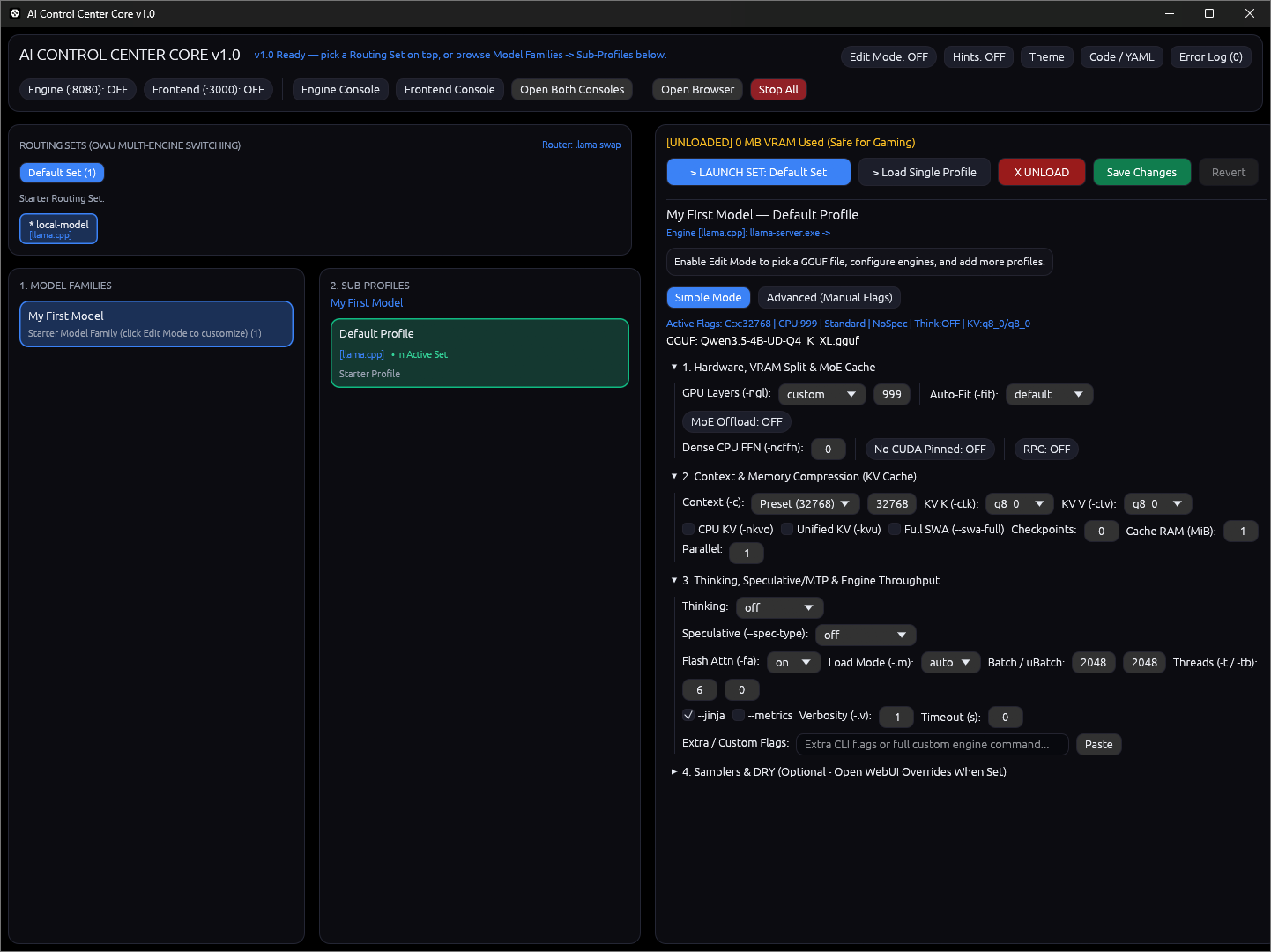
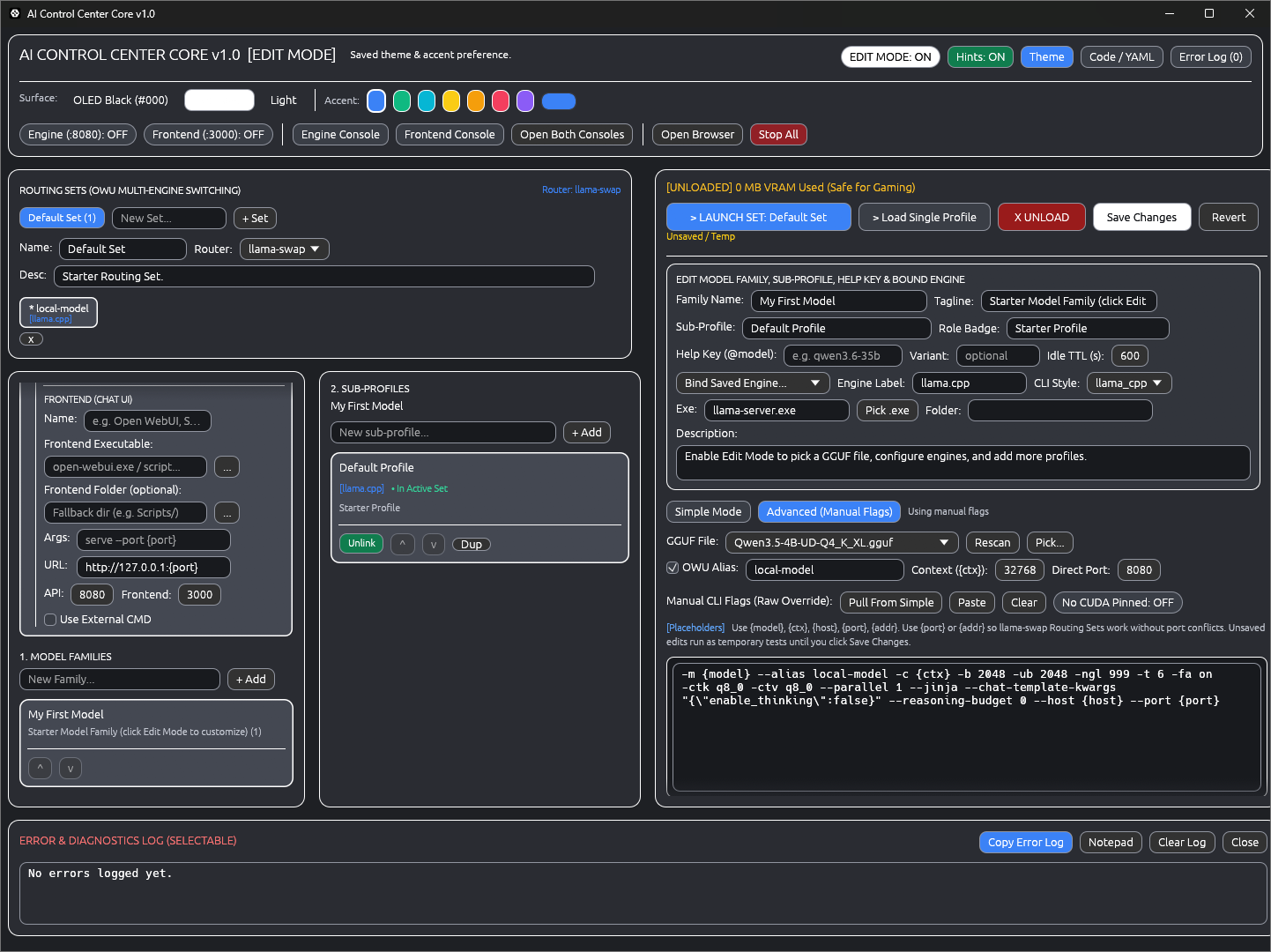
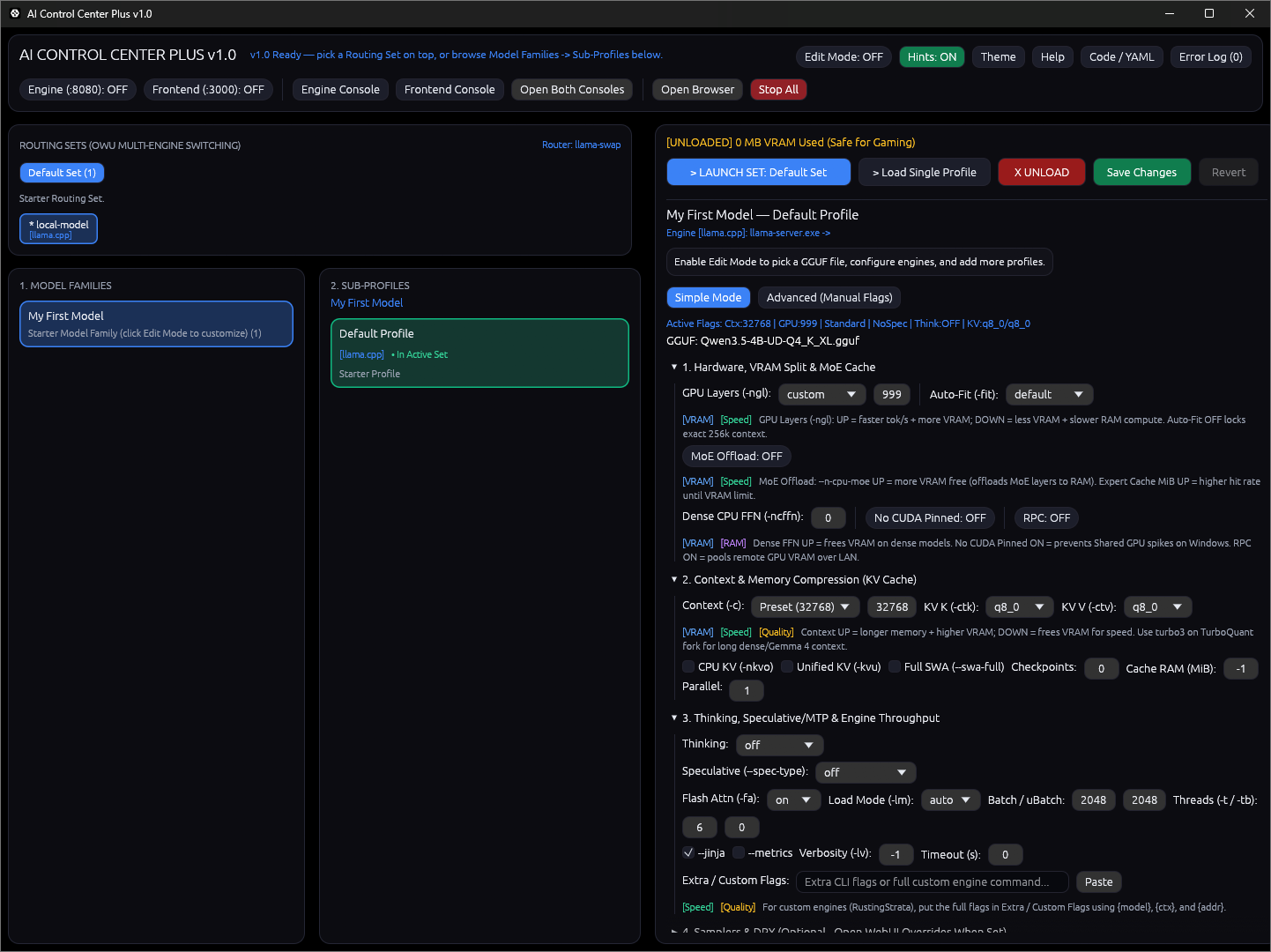
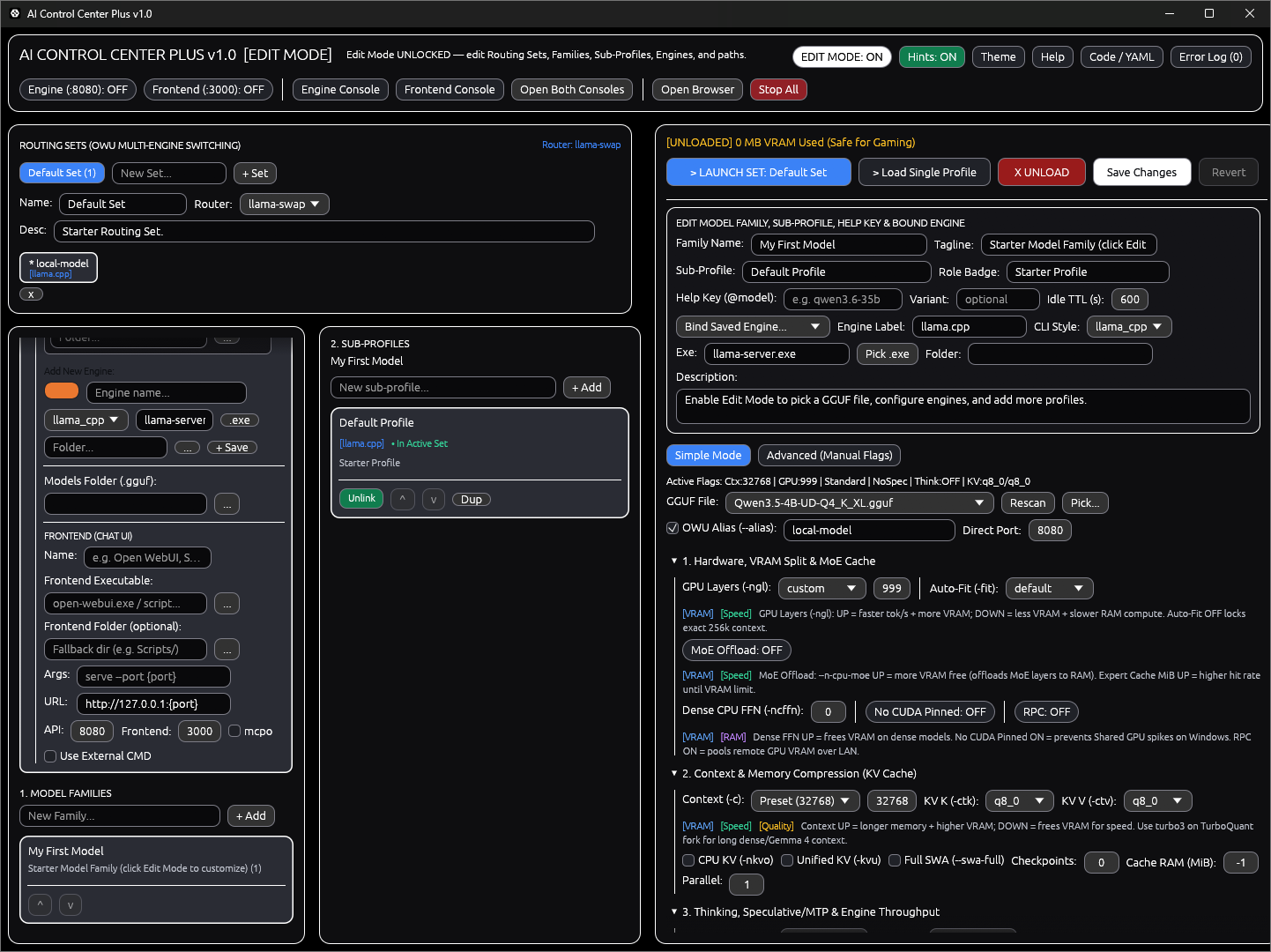
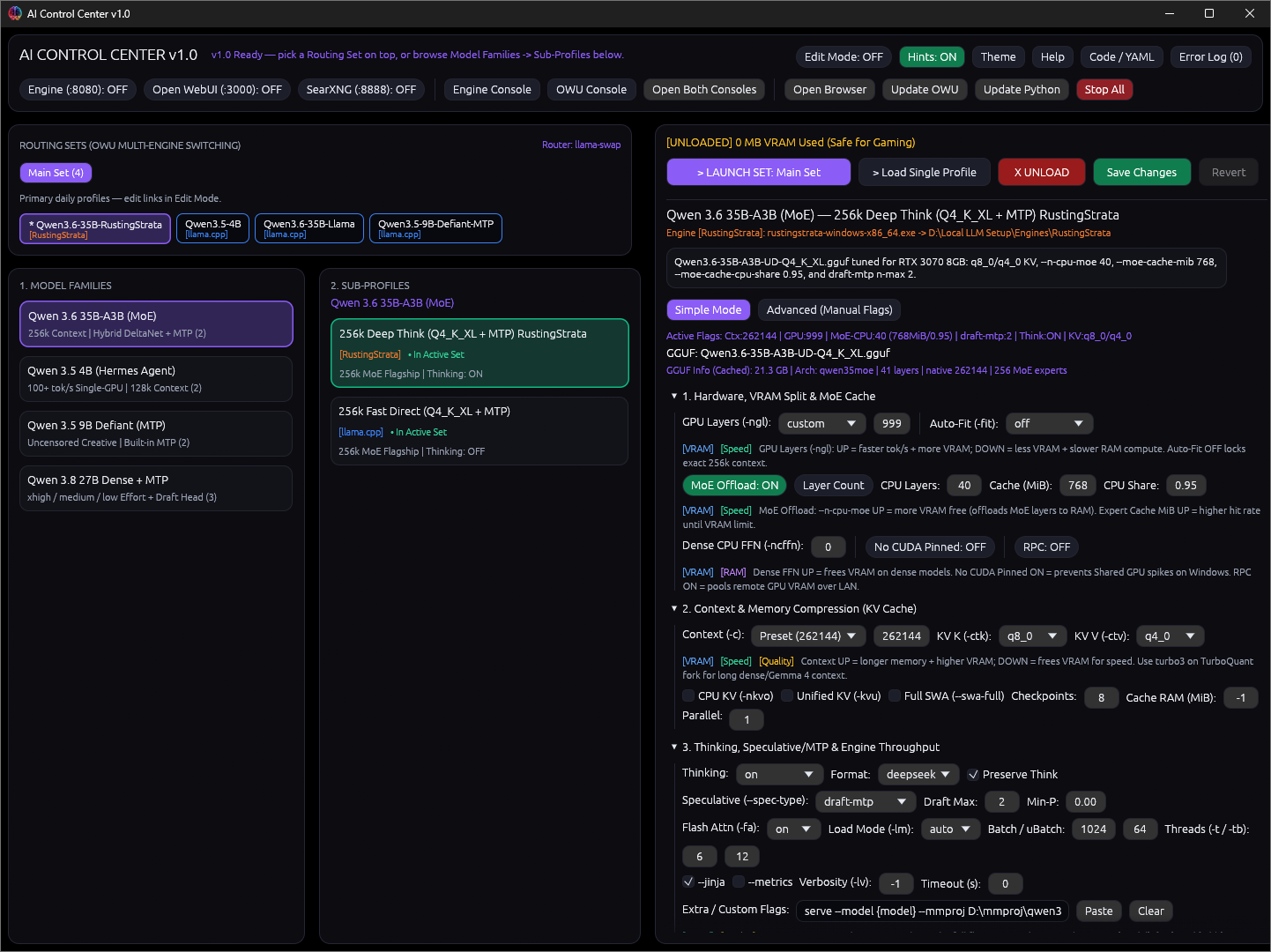
Showcase I made a native Rust GUI for llama.cpp & llama-swap that hot-swaps models and engines on the fly (Windows & Linux)

0 Upvotes

DISCLAIMER: This is completely written in Rust, and is 100% vibecoded, though thoroughly tested by me in every scenario i could think of, and worked to fix errors, GUI issues, QoL fixes.

I am not an IT guy [i am a dentist] but i personal life revolves around computers, automating stuff, making things i want etc. I, self taught in some frontend and Python, but i dont know Rust.


The What

AI Control Center

https://github.com/BaidDSB/ai-control-center

Basically, its a fast, native desktop control panel for running local AI on Windows and Linux. The BIGGEST feature is that it can hot-swap models and engines on the fly.

Configure your models, engines [you can color code engines too], front end, save your settings, and link the Routeing set and forget. You can even configure and use RPC right from the AI Control Center.

It has 2 versions, a Core and a Plus. Details are on github.

https://raw.githubusercontent.com/BaidDSB/ai-control-center/main/screenshots/core-1.png

https://raw.githubusercontent.com/BaidDSB/ai-control-center/main/screenshots/core-2.png

https://raw.githubusercontent.com/BaidDSB/ai-control-center/main/screenshots/plus-1.png

https://raw.githubusercontent.com/BaidDSB/ai-control-center/main/screenshots/plus-2.png

heres what my personal setup looks like and runs:

https://raw.githubusercontent.com/BaidDSB/ai-control-center/main/screenshots/personal.png

The Why

Well like i said before, my personal life revolves around computers and tech. I probably should have gone into IT, but i sucked at math so i didnt have the marks, nor the confidence to get into CSE. On my me time, i make all kinds of stuff, 3d models for games [i did extensive commission work in cities skylines assets, automating thing sin my pc, remote access etc].

I made this because i wanted to use local ai. I did so with LM studio but i realized i wanted more control plus Electron is slow af, so i switched to llama.cpp and OpenWebUI. and gradually i realized i want a quick launcher, which then grew into this, mostly to quick switch my models, and engines, use RPC, quick test new flags, save settings etc.

i really just made this for myself. But i decided to release this because if even 1 person find it useful, its great for me.

The Future

I have plans to integrate hermes, pi, make a dedicated RPC mode...


I hope you at lease give a read and see the pictures, even if you dont plan on using it. Thanks and enjoy!


r/LocalLLaMA • • 6h ago

Question | Help Is it true that even best open models are behind Haiku

Post image
278 Upvotes

Because of my personal position, I never worked with closed models. I used a lot, almost all popular open models, mostly for coding on different platforms. Last months, my main drivers are local 27B and QFN, and for heavy lifting I use cloud full Kimi or GLM. I have customized Pi harness with a lot of my custom plugins, and have no problems doing all my tasks with it, from embedded to Android.

But according to AA coding benchmarks, even K3.1 Pro is behind Haiku. Sonnet is miles ahead, whilst Opus almost streams tokens directly from intergalactic starship.

I could easily believe, that the benchmark is just corrupt by greedy Ram Altman and others, but many people on Reddit claim that it is sad, but true.

According to your experience, is that the case?


r/LocalLLaMA • • 6h ago

News AI agent ARTEX planted malware on Hugging Face and leaked its own keys

Thumbnail
maccus.fr
27 Upvotes

13 repos were infected


r/LocalLLaMA • • 7h ago

Discussion A bit of slop on 3D “modeling”: Qwen 3.8 Flash Next (125B) vs Inkling-2-Mini (26B)

Thumbnail
gallery
27 Upvotes

Same prompt for both: build an interactive V8 in Three.js. Both ran locally with custom dynamic quants at roughly 4-bit. Not a benchmark, just wanted to see what each model would spit out.

Qwen went for bare metal and exposed cams. Inkling went for red cylinder banks and a live stroke readout for all eight cylinders. Screenshots in that order.

Prompt:

Let's build a V8 engine.

A stunning, fully interactive 3D simulation of a 90-degree V8 on an industrial
engine test stand, in Three.js/WebGL, running in the browser.

Eight cylinders in two banks of four, cross-plane, with visible pistons, rods,
crankshaft, camshafts and valves.
Detailed heads, intake, exhaust headers, bolts and pipework.
Realistic PBR metals.
Real, synchronised animation: pistons driven off the crank, cams turning at
half crank speed, and a full four-stroke valve sequence.
An RPM slider from 0 to 4 000, plus slow motion.
WASD plus mouse walking, orbit, and smooth zoom.
Working controls: START / STOP, RPM CONTROL, CUTAWAY, EXPLODED VIEW, ASSEMBLE,
PART INSPECTION, RESET CAMERA.
Procedural geometry only — no downloaded models.
Every control functional, and nothing floating apart.

r/LocalLLaMA • • 7h ago

Question | Help Ling 3.2 Air Looping

11 Upvotes

I’ve been trying to get Ling 3.2 Air working with llama.cpp, but no matter what I do (including changing sampler params and experimenting with YaRN) it ends up looping once context reaches around 8000-12000 tokens. Has anyone been able to get the model to work without looping at longer context depths, using either llama.cpp or any other engine? I don’t have a machine capable of running it with vLLM or SGLang.


r/LocalLLaMA • • 7h ago

Question | Help Testing a new KV-cache index for long-context decoding (32k → 1M tokens). Results look promising; looking for feedback on what to test next

7 Upvotes

This post is made with the help of AI.

I've been building a sparse-attention method for long-context decoding. Each decode step, it reads only a small part of the KV cache, exactly, and estimates the rest. The goal is faster decoding at long context, where reading the KV cache costs more than reading the weights. New tokens are added cheaply, with no rebuilds as the context grows.

I'd like opinions on the results and on whether my test setup is fair.

Setup

  • Real Q/K/V dumped from Qwen2.5-1.5B (32k) and Qwen2.5-0.5B-Instruct (256k–1M, stretched with YaRN), CPU only.
  • Haystack is WikiText-103 with a hidden passcode ("needle"). The queries tested are the question tokens.
  • Compared against Quest, my own reimplementation of RetroInfer's index ("RetroInfer-style", cluster centroids plus estimating the rest), and exact top-k with no estimation.
  • Every method also attends exactly to the first 4 tokens and the last 512. "Budget" means extra keys attended exactly.
  • One selection per KV head, shared by all the query heads in its group (GQA).
  • Error = ‖approx − full attention output‖ / ‖full‖, averaged over heads and queries.
  • Needle recall = share of the model's real attention on the needle that the method attended exactly.
  • Bytes = KV bytes read per step, as a % of full attention.

32k context, Qwen2.5-1.5B (full-attention prefill; the model answers the needle correctly)

BudgetMethodErrorNeedle recallBytes read
256Quest0.3370.667.0%
256RetroInfer-style0.1540.947.0%
256Exact top-k0.2030.990.8%*
256Mine0.0830.965.2%
512Quest0.3010.747.8%
512RetroInfer-style0.1360.957.8%
512Exact top-k0.1641.001.6%*
512Mine0.0640.998.0%
1024RetroInfer-style0.1130.979.3%
1024Mine0.0481.0013.4%

*Exact top-k isn't practical: it has to score every key to find the top ones. Its bytes are an ideal lower bound.

It also holds up when half the context is added after the index is built (error 0.090 against 0.164 for RetroInfer-style, at budget 256).

Long context, Qwen2.5-0.5B-Instruct, budget 2048 (0.2–0.8% of the context)

Method256k500k1M
Quest0.4950.5340.556
RetroInfer-style0.3190.3340.344
Exact top-k0.1290.1560.166
Mine0.1040.1280.145

Bytes read at 1M: 3.2% for mine, against 6.5% for RetroInfer-style and Quest.

How cost grows with context (one KV head, MB read per decode step)

ContextFull attentionRetroInfer-styleMine
32k8.41.01.4
256k674.73.6
1M25616.58.3

Insert cost stays flat from 32k to 1M (~30–40 µs per key in numpy).

Limitations (please poke holes)

  • These are small models. At 256k+ I had to use the 0.5B model, and it fails the needle test somewhere between 16k and 64k even with full attention. So at those lengths I'm measuring how well each method reproduces the model's real attention output, not whether answers stay correct.
  • A 1M-token prefill on CPU needed a sliding window (4k + sinks). The question tokens use full attention, but the haystack keys were computed with local context only.
  • Queries come from the prompt, not from generated tokens.
  • Bytes read is a stand-in for speed. No GPU kernel has been timed yet.
  • The baselines are my reimplementations, not the original code.

Questions for you

  1. What error level stops mattering in practice? I need to test end-to-end (perplexity, RULER, LongBench) next. Which would you trust most?
  2. Which long-context model that fits on one 24 GB GPU would you use for a real 128k–1M end-to-end test?
  3. Are my baselines fair? Should I add others (ShadowKV, MagicPIG, DeepSeek-style sparse attention)?
  4. Would a llama.cpp integration be useful to you, given that the cache read per token drops to a few percent at long context?

r/LocalLLaMA • • 8h ago

Discussion What happened to Qwen 4 35B ?

0 Upvotes

Has there been any news on this?


r/LocalLLaMA • • 8h ago

Showcase Gemini Neon tuned Mac M1/M2 kernel for Inkling 2 Mini :: All Vibes and toks

2 Upvotes

I've been using my Gemini subscription to help get the most out of my Macbook M2 Max 64gb and Neon seems to have hit it out of the park with integrating different approaches to this model. All of the kernel stuff is beyond me, I simply pointed it at different references for useful information.

This may or may not be of interest to any Apple Silicon users >M2 and comes with No Warranties whatsoever. If I can't understand what the robot wrote I cannot give any guarantees.

Let the slop begin.

Title: Experimental MLX M1/M2 kernels + W4W8 quant for Inkling-2-Mini (500+ tok/s prefill, 30–43 tok/s decode, 512k NIAH in 38 GB on M2 Max)


I put together a vibe-coded experimental set of MLX Metal kernels and a matching mixed-precision quant for Inkling-2-Mini specifically targeting M1/M2 Macs (tested on a 64 GB M2 Max). No guarantees or production claims here—just sharing the code, weights, and benchmarks in case they're useful to other M1/M2 users.

Why a separate quant + kernel pass for M1/M2

  1. Affine instead of NVFP4/MXFP8: Inkling-2-Mini trains and ships natively in NVFP4 (layers 0..19 experts) and MXFP8 (last 4 readout layers 20..23). M1/M2 has no hardware microscaling decode, so unpacking NVFP4/MXFP8 in software costs ~30–40% decode speed vs MLX's affine (gs=64) kernels.
  2. Keep the last 4 layers at 8-bit: Uniform 4-bit (W4A16) gets trapped in thinking loops on long coding tasks (0/12 on a 64k DAG workflow test), and crushing layers 20..23 to 4-bit drops accuracy (10/12). Mirroring the training split—4-bit affine on layers 0..19 experts, 8-bit affine on layers 20..23 experts + attention/embed/lm_head, FP32 on AttnRes/routers—recovers 12/12 in 18 GB.
  3. FP16 activation path + fused kernels: On M1/M2, recasting BF16 leaves to FP16 alongside fused Metal kernels (short_conv, moe_short_conv, dynamic_conv, qkv_post, Split-K relative attention) and projection fusion gives a large prefill and decode jump over base mlx-lm PR #2086 (e2b5bbd) and oMLX 0.8.3.
  4. Adaptive DSpark MTP + SpeculativeRotatingKVCache: Adds 16 tokens of tail slack to the 40 sliding-window visits so MTP rollback stays capped instead of growing all 48 visits (cutting 512k MTP KV memory by 6x), plus an adaptive depth controller that backs off to d=0 on high-entropy prose while staying speculative on code/tool JSON.

Benchmarks (64 GB M2 Max)

Up to 32k context (256 generated tokens):

ContextBase PR #2086 (e2b5bbd)oMLX 0.8.3 (M1/M2 FP16, NVFP4)This (W4W8 + FP16)
512 tok365 tok/s pre / 25.9 tok/s dec301 tok/s pre / 24.0 tok/s dec549 tok/s pre / 30.9 (33.2 d=2) dec
4,096 tok417 tok/s pre / 26.7 tok/s dec498 tok/s pre / 21.0 tok/s dec603 tok/s pre / 29.9 (30.9 adapt) dec
16,384 tok407 tok/s pre / 25.2 tok/s dec504 tok/s pre / 20.5 tok/s dec543 tok/s pre / 28.2 tok/s dec
32,768 tok374 tok/s pre / 23.6 tok/s dec466 tok/s pre / 19.0 tok/s dec501 tok/s pre / 26.1 tok/s dec (21.2 GB peak)
  • Coding / tool-calling (Adaptive MTP d<=2): 37–48 tok/s (75–89% acceptance).
  • 512k NIAH (512,444 tokens, The Man Who Was Thursday + The Count of Monte Cristo): 5/5 verbatim recall across 5%–95% depth, 8.56 tok/s decode, 37.99 GB peak RAM (90.8 min cold prefill; only 8 of the 48 visits are full-attention, so KV grows at 32 KB/tok).
  • Offline KV caching: Included in inkling_mlx.py (--build-cache / --cache, 16-bit or 8-bit .safetensors including conv + drafter state, <1 ms in-memory branching). A 128k cache is 4.3 GB (2.3 GB at 8-bit) and reloads in under a second.
  • Capability checks: 12/12 on a 64k one-shot DAG workflow engine test, 12/12 on a fictional-world tool-calling suite (including a 9-file refactor and 28.6k pure long-context log debugging with 0/116 malformed tool calls), plus clean one-shot Three.js and Web Audio apps.

All converter scripts, benchmark harnesses, and the diff against PR #2086 are in the GitHub repo if anyone wants to test or pull pieces into upstream mlx-lm.


r/LocalLLaMA • • 9h ago

New Model NVIDIA just quietly dropped open weights for Nemotron-Labs-Image-30B-A3B

Thumbnail
gallery
421 Upvotes

NVIDIA just quietly dropped open weights for Nemotron-Labs-Image-30B-A3B on Hugging Face, the autoregressive image generator from its new Nemotron-Labs-VisualCreation ("Pixel as Code") framework.

Nemotron-Labs-VisualCreation is an agentic framework for creating expressive raster images and editable visual artifacts, including webpages, presentations, documents, charts, and scientific figures.

In key benchmarks output outperforms GPT Image 2 and Nano Banana Pro.

Nemotron-Labs-Image-30B-A3B is its raster image-generation component:

30B total / 3B active MoE (Nemotron-H hybrid Mamba-2 + attention, initialized from Nemotron 3 Nano), trained with progressive mid-training + GRPO

Hugging Face: https://huggingface.co/nvidia/Nemotron-Labs-Image-30B-A3B


r/LocalLLaMA • • 9h ago

Discussion What new upcoming local model are you excited about?

0 Upvotes

What model that should be coming out in the next couple of months are you really excited about? Local models only please.


r/LocalLLaMA • • 10h ago

News Pine: an MIT agent harness where agents wake up on events (a new file in a folder, MQTT, webhooks, Telegram), and you can point it at your own llama.cpp / vLLM / LM Studio server

17 Upvotes

Most agent harnesses wait for you to type something, or run on a schedule. Pine adds a third trigger, which is events. An agent can subscribe to a folder, an MQTT topic, a webhook, an FTP endpoint or a Telegram message and start working when something shows up there. The README's own example is a scanner folder: a letter gets scanned, the agent reads it and puts what's due on a todo list.

Posting it here because it takes a local model server. You add a llama.cpp, vLLM or LM Studio endpoint by its address with pine model add, then switch with /model. It can also log in with a Claude or ChatGPT subscription if you'd rather use those.

A few other things from the README:

  • MIT, TypeScript, installed with "npm install -g u/pmndre"
  • macOS and Linux. Windows only through Docker for now
  • pine start runs it as a daemon, so agents keep reacting with no terminal open
  • You don't edit config files. You tell the main agent what you want and it creates the agents, MCP servers, event sources and schedules through tool calls
  • Agents in safe mode work inside a sandbox

It's still moving fast. The tags are pre-release builds (v0.56.0-next.5 went out today).

What the README doesn't say is how small a local model can be and still get through the event to tool call loop without falling over. If anyone has run it against a local model, which one held up?

https://github.com/pmndre/pine


r/LocalLLaMA • • 11h ago

New Model Dankpaws/ERNIE-5.5-Flash-Preview-DankAttn-w2-g32 - 96 GB M5 Ultra in pure Metal 4. 1,800 tok/s prefill, 65–87 tok/s decode with DankAttn.

Thumbnail
huggingface.co
13 Upvotes